Languages
Sunday, November 8, 2026



News and Views from the Global South
Population

Kenya Set to Run Away With Medals
On a chilly morning at the Moi International Sports Centre in Nairobi, the largest multi-purpose sports centre in Kenya, 800m world record holder David Rudisha looked like just another athlete.Laos’s Rural Women Await Midwives
A year after the Laotian government launched a safe pregnancy programme news of this initiative, involving the dispatch of teams of midwives across the country, is yet to reach women in the remote communities.
Q&A: “In Portugal, We Fight the Illness, Not the People Who Suffer from It”
Portugal’s anti-drug policies have been gaining international visibility since this country began to publish the results of its 2001 decision to eliminate all criminal penalties for personal possession of drugs.
Lebanon Heading for Failed State Status?
Every day Lebanon is being plunged further into a state of general insecurity, as chaos from the war in Syria seeps across the border.
Trading Across the Line of Control
As part of recent confidence building measures aimed at minimising tensions between India and Pakistan, which arose largely due to conflicting claims over Kashmir, the two countries have decided to make the Valley an economic bridge, rather than a bone of contention.
Papua New Guinea Casts Wide Net Against Malaria
In Papua New Guinea, a Pacific Island nation located south of the equator, 90 percent of the population is at risk of malaria and 1.9 million cases are reported every year. But, according to a recent medical study, a programme to distribute long-lasting insecticide treated mosquito nets to every district in the country has dramatically reduced malaria infections.
Security Gaps Fuel Cote d’Ivoire Prison Escapes
Eliane Negui knew just what to do when she got word that a group of inmates had escaped from Abidjan’s main prison, MACA, earlier this month. After all, the 24-year-old, who has lived across a dirt road from the facility for nine years, had witnessed the same scenario just two months before.
In the Pursuit of Education: Burkina Faso’s School for Shepherds
Salou Bandé is proud to stand at the front of the only classroom in the village of Bénnogo, 90 kilometres north of the Burkina Faso capital, Ouagadougou, sharing his knowledge with his students. He is part of an initiative to improve education for nomadic children in the West African country.
Athletes Wither Under Government Apathy
He dreamed of one day running on international athletic tracks and worked hard for seven long years to make this a reality.
Officials Decry “Appalling Gaps” in Global Data on Women
The World Bank and U.S. government on Thursday each announced major new initiatives aimed at expanding knowledge on the experience of women around the world, while acknowledging that much remains to be done on filling the global “data gap” on women.
Malnutrition Implicated in Child Killer Epidemic
Health experts are blaming high malnutrition levels for an outbreak of hand, foot and mouth disease (HFMD) that has killed more than 54 children in impoverished Cambodia since April.Death Stalks Pregnant Women in East Myanmar
From a wooden, weather-beaten building on the edge of this border town, Mahn Mahn charts dangerous missions deep Myanmar (also Burma) for the 2,000-odd health workers under his wing.
Poverty Drives Child Labour
In an informal settlement of 10,000 people on the outskirts of Papua New Guinea’s capital, Port Moresby, Tembari Children’s Care – a new grassroots initiative – is providing protection, food and education to orphans and abandoned children who would otherwise join the high numbers of child labourers in this Melanesian country.
Pacific Coastal Fisheries in Dire Need of Protection
Coastal fisheries in Papua New Guinea, used primarily by local subsistence fisher folk, will face increasing pressure from climate change, compounding the twin problems of population growth and overfishing.
Archaic Laws Stymie HIV/AIDS Work in Sri Lanka
Sri Lanka has long enjoyed a low 0.1 percent HIV prevalence but, as the number of fresh infections rises steadily, experts are calling for a change in the country's archaic laws that make sex work illegal and criminalises homosexual activity.
Vietnamese Girls Grapple With Changing Sexual Climate
Conservative attitudes toward women die hard in Vietnam, as seen in the country’s worsening sex ratio at birth (SRB). Yet, social mores have relaxed sufficiently for women to tune in to late night TV talk shows to learn about the acceptability of one-night stands.
Women’s Inequality Linked to Soaring Population
The world’s population now stands at about seven billion, and by 2050, this figure will hit a whopping nine billion.U.S.: Latinos Could Shift Outcome of 2012 Elections, Experts Say
As the Latino population in the United States rises, the demographic shift will affect future as well as current voting habits, and therefore election outcomes, in the United States, according to several experts.
Birth Control – Roping in Pakistan’s Men
“No scalpel, no stitch and no rest needed,” guarantees Dr. Ghulam Shabbir Sudhayao, referring to the surgical procedure called vasectomy - the least popular method of birth control around the world, including Pakistan.Family Planning Summit Offers New Hope
The Summit on Family Planning that is taking place in London on Wednesday is a bid to get governments around the world to commit more resources to safeguarding women’s reproductive rights, according to the executive director of the United Nations Population Fund (UNFPA).
Taliban Thwarts Global Polio Eradication
By ordering a ban on polio immunisation, in its strongholds along the Afghanistan-Pakistan border, the Taliban is holding up an ambitious global programme to rid the world of the crippling childhood disease, say World Health Organisation (WHO) doctors.« Previous Page — Next Page »





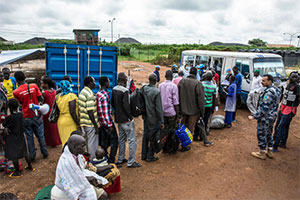 One Thousand Internally Displaced Persons (IDPs) Relocated from Tomping Camp in South Sudan. Credit: UN Photo/Isaac Billy
It took hundreds of thousands of years for the world’s human population to cross one billion in 1804. Approximately 200 years later, the population has multiplied sevenfold. In 2023, the global population crossed 8 billion, and is expected to reach 9 billion before 2050. With the planet more crowded than ever, it is essential to keep track of population trends, urbanization, migration, and reproduction across the world.
Life expectancy has seen significant strides in the past century, largely due to economic development and increased standards of living. On the contrary, trends in global fertility are shifting, with certain regions in Africa and Asia reporting higher rates, while parts of Europe and North America report stagnant or lower rates. This is in part due to differences in sexual and reproductive healthcare, as well as societal and economic conditions around the world. For example, child marriage is prevalent in certain societies, where childbearing is also considered a familial duty. Meanwhile, stagnating economies frequently experience lower marriage and childbearing rates.
The increase in migration and urban development around the world is also linked to global population trends. By 2050, it is expected that approximately 66 percent of all people will live in cities. Furthermore, global crises such as warfare and natural disasters also prompt transnational migration. Transnational migration is linked to a variety of socioeconomic issues in both host and receiving countries: migrants often leave developing countries with less access to educational and economic opportunities and arrive in developed countries where they are frequently the targets of ethnic, racial, and cultural discrimination, and economic exploitation. Recent crises in Europe and the United States demonstrate the importance of advocating for migrants worldwide. As migrants from the Global South are increasingly stripped of their legal and civic rights in unlawful deportations, or targeted in acts of identity-based violence, it is essential to keep track of population trends and protect the human rights of migrant populations. Climate-related disasters are now a major driver of displacement, with nearly half of all new internal displacements in 2025 being disaster-related.
IPS is devoted to covering issues surrounding population trends, migration, and reproduction through its compelling articles, which use both statistics and human stories to provide readers with robust and informative viewpoints.

The Week with IPS

NEXT STOP - SDGs
Tracking global progress towards a sustainable world
Tracking global progress towards a sustainable world
