Languages
Thursday, October 8, 2026



News and Views from the Global South
Labour

Towards Safe Migration and Decent Work for Women in Nepal
In August it’s blazing hot in Kathmandu. Dawa Dolma Tamang, 32, sits on a chair at Pourakhi’s office—an organization that works with migrant women workers—staring out of the window. “I want to send my children to a better school and support my husband to make a decent living. I want to make my family whole again," she says.
In Host Country Lebanon, Refugee and Rural Women Build Entrepreneurship, Cohesion and Future
“When we were forced to leave our country, I never thought that a community in Lebanon would accept and treat me as an active member, the way I have been at the Kfeir Women’s Working Group,” says Hiba Kamal, an 18-year-old refugee from Syria who travelled to Lebanon with her family five years ago fleeing instability in her own country.
Economic Growth in Bangladesh: Challenge and Change for Women
A recent research study “Bangladesh: Looking Beyond Garments” conducted by the Asian Development Bank ADB has revealed that the positive economic turnaround in Bangladesh is largely due the rising presence of women in the workplace.
Italy’s Second Economy: The Impact of Bangladeshi Migration
Hardly a street can be found in Rome without a Bangladeshi-run mini-market. Much like the typical Italian coffee bars, they have now become an intrinsic part of Roman infrastructure.
Migrant Labour Fuels Tensions in Mauritius
They come from Bangladesh, China, India and Madagascar, mainly to run the machines in the textile industry here. But they do all kinds of other jobs too, from masons to bakers, house cleaners and gardeners.
Asia, Looking Beyond the Green Revolution
 More than 2.2 billion people in Asia rely on agriculture for their livelihoods, but the Asian Development Bank warns that stagnant and declining yields of major crops such as rice and wheat can be ultimately linked to declining investments in agriculture. Public investments in agriculture in India, for instance, have been roughly the same since 2004.

Nurturing African Agriculture
While agriculture could be the driving force to lift millions of Africans out of poverty and alleviate hunger, its full potential remains untapped. For example, only between five and seven percent of the continent’s cultivated land is irrigated, leaving farmers vulnerable to climate shocks like the devastating El Nino-driven drought in southern Africa. That's why international agencies like the U.N. Food and Agriculture Organization (FAO) are forging key partnerships to enhance agricultural production, sustainable natural resource management and increased market access. 
Ships Bring Your Coffee, Snack and TV Set, But Also Pests and Diseases
“Every evening, millions of people all over the world will settle into their armchairs to watch some TV after a hard day at work. Many will have a snack or something to drink…
Smart Technologies Key to Youth Involvement in Agriculture
She is only 24 and already running her father’s farm with 110 milking cows. Cornelia Flatten sees herself as a farmer for the rest of her life.
India’s New Maternity Benefits Act Criticised as Elitist
The passage of the landmark Maternity Benefits Act 1961 by the Indian Parliament, which mandates 26 weeks of paid leave for mothers as against the existing 12, has generated more heartburn than hurrahs due to its skewed nature.
Ethiopian Food Aid Jammed Up in Djibouti Port
Bags of wheat speed down multiple conveyor belts to be heaved onto trucks lined up during the middle of a blisteringly hot afternoon beside the busy docks of Djibouti Port.
Youth Key to the Success of the SDGs in Kenya
Consider this: in 1956 Sweden and Kenya’s population was roughly at 7 million. Today Sweden has about 9.8 million, while there are about 44 million Kenyans. Fertility levels are declining gradually and Kenyans are living longer. It is estimated that there will be 85 million people in Kenya by 2050, with three quarters of these being below 35 years. While Kenya’s median age is 19, Sweden’s is 42.
Youth Employment: Turning Workplace Partnerships into Opportunity
Many of us can remember the difficulties of getting our first job – the searching, the frustration of rejection, the nervous wait for an interview or the first day of work. Today’s staggering unemployment rates in many countries make it an especially difficult time for young job-seekers.Expansionary fiscal consolidation myth
The debt crisis in Europe continues to drag on. Drastic measures to cut government debts and deficits, including by replacing democratically elected governments with ‘technocrats’, have only made things worse. The more recent drastic expenditure cuts in Europe to quickly reduce public finance deficits have not only adversely impacted the lives of millions as unemployment soared. The actions also seem to have killed the goose that lay the golden egg of economic growth, resulting in a ‘low growth’ debt trap.
Rickshaw Painting in Digital Age
 With the advent of the digital printing press, Riskshaw painting a previously well known art form is on the verge of extinction. Many painters had to switch their profession to survive the "digital revolution".

The UN Steps up Efforts to End Child Marriage
Barely 17 years old and from the Gajapati district in Odisha, India, Susmita has never gone to school. She rears the few animals her family owns, and this is her primary duty besides attending to household chores.
Thinking Global? Act Provincial
The least populated, northernmost province in North America even its own citizens dread to go has a per capita GDP of C$58,452 compared with C$3,439.28 for the entire Philippines.
Climate-Smart Agriculture for Drought-Stricken Madagascar
Mirantsoa Faniry Rakotomalala is different from most farmers in the Greater South of Madagascar, who are devastated after losing an estimated 80 percent of their crops during the recent May/June harvesting season to the ongoing drought here, said to be the most severe in 35 years.
Poverty, Vulnerability and Social Protection
According to the World Bank, the MDG target of halving the share of the poor was achieved by 2008, well in advance of 2015, the target year. However, increased unemployment and lower incomes in recent times remind us that poverty is not an unchanging attribute of a shrinking group, but rather, a condition that billions of vulnerable persons risk experiencing.
New Alliance to Shore Up Food Security Launched in Africa
As over 20 million sub-Saharan Africans face a shortage of food because of drought and development issues, representatives of the U.N. Food and Agriculture Organisation (FAO) and the Pan African Parliament (PAP) met in Johannesburg to forge a new parliamentary alliance focusing on food and nutritional security.
Newly Empowered Black Farmers Ruined by South Africa’s Drought
Almost half a decade of drought across most of South Africa has led to small towns in crisis and food imports for the first time in over 20 years, as well as severely hampering the government’s planned land redistribution programme.« Previous Page — Next Page »





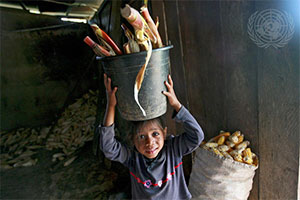 Timorese Girl with Fresh-Picked Corn. Credit: UN Photo/Martine Perret
A global common denominator is the need for a decent job. The economic realities of each country determine just how difficult it is to find one. Despite the labour movement's achievements, serious challenges persist: gender discrimination, child labour, worker migration, the digital divide and AI automation, evaporating pensions, unsafe workplaces, corporate pressure against union organising, negative impacts of trade agreements, and the precariousness of informal employment. The 2025 UN SDG Report identifies jobs and social protections as one of the six priority areas requiring urgent action, with progress either stalled or reversing in many developing nations.
In recent years, the fight to protect labour equality has taken on new dimensions with the rise of Environmental, Social and Governance standards. With the Social aspect aiming to promote equality and human rights, ESG principles have strengthened labour advocacy within corporate and governmental regulatory landscapes. In particular, ESG has become much more institutionalized in emerging economies such as Brazil and China. IPS follows the world’s workers as they confront these challenges - their setbacks and their successes.

The Week with IPS

NEXT STOP - SDGs
Tracking global progress towards a sustainable world
Tracking global progress towards a sustainable world
