Languages
Thursday, October 8, 2026



News and Views from the Global South
Labour

Chronic Hunger Lingers in the Midst of Plenty
In a fraught global economic environment, exacerbated by climate change and shrinking resources, ensuring food and nutrition security is a daunting challenge for many nations. India, Asia's third largest economy and the world's second most populous nation after China with 1.3 billion people, is no exception.
African Leaders Driving Push for Industrialisation: UN Official
Industrialisation in Africa is being driven by African leaders who realise that industries as diverse as horticulture and leather production can help add value to the primary resources they currently export.List of Acts President Must Do for Disaster Risk Reduction and Management
President Rody Dutuerte’s SONA could not possibly give details about every important program of his administration. But a SONA does mark for the people which activities a president thinks should be given top priority.
Climate Migrants Lead Mass Migration to India’s Cities
Deepa Kumari, a 36-year-old farmer from Pithoragarh district in the Himalayan state of Uttarakhand, lives in a one-room tenement in south Delhi's Mongolpuri slum with her three children. Fleeing devastating floods which killed her husband last year, the widow landed up in the national capital city last week after selling off her farm and two cows at cut-rate prices.
Fertilizer Access Grows Farmers, Food and Finance
Brightly coloured cans, bags of fertilizer and packets containing all types of seeds catch the eye upon entering Nancy Khorommbi’s agro dealer shop tucked at the corner of a roadside service station.
100-year-old Boat Market in Pirojpur
 The use of traditional boats may be disappearing fast, but there is one place in Nesarabad upazila (formerly Swarupkathi) in Pirojpur, where you can still buy newly made boats for a trifle amount.

Modern-day Slavery in Oman? Domestic Workers in Peril
In order to escape poverty and support their families back home, thousands of domestic workers from South and South-East Asia migrate to Oman with the promise of stable employment in local households.
Ramifications of Terror Attacks in Bangladesh
At a time when Bangladesh has broken the 6 percent growth trap and has begun its journey towards achieving a faster growth of about 7 percent, and at a time when Bangladesh has achieved the status of a lower middle income country with a per capita income of USD1314 in 2015, it experiences the greatest shock in recent times. This has suddenly changed the perspective on Bangladesh. The ruthless killing of 20 lives, including 17 foreigners at the Holey Artisan Bakery of Gulshan in Dhaka on July 1, 2016, by terrorists has brought new realities for Bangladesh. A country which boasts to be a moderately Islamic country, holding the values of Islam yet being tolerant to other religions and a country that is reputed for its warmth and hospitality towards foreign nationals, has come under the global radar due to the brutality of recent terror attacks. While the grief for the lost lives is going to make a permanent place in our hearts, the implications of this painful episode on other spheres of lives cannot be ignored either.
Rewriting Africa’s Agricultural Narrative
Albert Kanga Azaguie no longer considers himself a smallholder farmer. By learning and monitoring the supply and demand value chains of one of the country’s staple crops, plantain (similar to bananas), Kanga ventured into off-season production to sell his produce at relatively higher prices.
Women Empowerment Holds the Key for Global Development
Latin America's inclusion of women in its development model, with greater participation within the work force and improved wage conditions, was a decisive factor in the region's successful diminishment of extreme poverty.Increased Adb Aid Will Help Cushion Economic Blows
The Philippines faces prospects of slower growth this year because of external factors. One such factor is the effect of Brexit on the world economy. With Brexit causing the European Union’s already sluggish economy to shrink further, Philippine exports to EU countries in 2016 may end up being less than half of last year’s.
Entrenched Inequalities
Do a girl born in a poor household in rural Balochistan and a boy born in a rich household in Karachi have the same or even a similar set of opportunities in life? Are their chances of acquiring an education similar? Do they have access to comparable healthcare services and facilities? Do they have equal opportunities for access to physical infrastructure and the freedom of movement and association?
Displaced Youth: Selling Souls to Sex and Drugs
Omar’s striking blue eyes and well-built physique are accentuated by his fashionable, tight-fitting apparel. At first glance, one would regard him as a carefree young man, blessed with the gifts of intellect and beauty. However, appearances can be deceptive. The traumas of war, displacement and isolation hang over Omar like an ominous shadow.We’ve Won a Monumental UN Victory, so What?
The important thing about the West Philippine Sea (South China Sea), as far as day-to-day life for Filipinos is concerned, is that our fishermen may continue to do what they and their ancestors have been doing since time immemorial—fish in the waters of the West Philippine Sea. Both because of that, and the affirmation of Philippine sovereignty over those waters, which are inside the UN definitions of what belongs in our EEZ (exclusive economic zone), we rejoice that the UN Permanent Court of Arbitration decided in our favor on Tuesday.
Is Sustainable Development Hindering Economic Recovery?
The global economic and employment situation is alarmingly protracted, with recovery not expected any time soon. In October 2012, then IMF chief economist Olivier Blanchard indicated he did not see a global economic recovery before 2016.
Bangladeshis among Domestic Workers Trapped in Oman: HRW
Many migrant domestic workers including Bangladeshis are trapped in abusive employment in Oman with their plight hidden behind closed doors, Human Rights Watch (HRW) said in a report released today.
Unions of the Poor
One of the greatest outcomes for development economic policy is, or should be, the reduction in poverty and unemployment, both in the rural and urban areas. Recent reports show that poverty in Pakistan, based on cost of basic needs, has come down from around 64.2pc in 2001-02 to 29.5pc in 2014. Based on food energy intake, poverty during this period has declined from 34.6pc to 9.31pc.
Is Federalism Pro-poor?
Poverty, according to the United Nations, is “a denial of choices and opportunities, a violation of human dignity. It means lack of basic capacity to participate effectively in society. It means not having enough to feed and clothe a family, not having a school or clinic to go to, not having the land on which to grow one’s food or a job to earn one’s living, not having access to credit. It means insecurity, powerlessness and exclusion of individuals, households and communities. It means susceptibility to violence, and it often implies living in marginal or fragile environments, without access to clean water or sanitation.”
The UN and Global Economic Stagnation
When the financial crisis preceding the Great Recession broke out in late 2008, attention to the previously ignored UN Secretariat’s analytical work was greatly enhanced. This happened as the UN and the Bank of International Settlements (BIS) had been almost alone in warning, for some years, of the macroeconomic dangers posed by poorly regulated financial sector developments.How Russia Will Use Brexit to Fight Sanctions
FORECAST EU sanctions against Russia are all but guaranteed to remain in place through 2016, but Moscow will work in the second half of the year to get them eased in 2017. Russia will capitalize on divisions in the European Union, which will only widen in the wake of Brexit, to oppose sanctions. Moscow will step lightly, however, to avoid provoking its European rivals ahead of the next sanctions vote.
How Rulers Affect Migration Measurement of Life
Will a Duterte administration change the migration pattern of Filipinos searching for a level playing field and a better life? IF career criminals are stopped dead on their tracks, literally or otherwise—not just petty thieves, drug lords instead of drug users, criminal coddlers as opposed to only small-time hoods, plunderers and not just frontline government bribe takers;« Previous Page — Next Page »





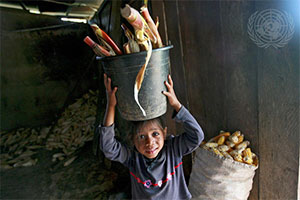 Timorese Girl with Fresh-Picked Corn. Credit: UN Photo/Martine Perret
A global common denominator is the need for a decent job. The economic realities of each country determine just how difficult it is to find one. Despite the labour movement's achievements, serious challenges persist: gender discrimination, child labour, worker migration, the digital divide and AI automation, evaporating pensions, unsafe workplaces, corporate pressure against union organising, negative impacts of trade agreements, and the precariousness of informal employment. The 2025 UN SDG Report identifies jobs and social protections as one of the six priority areas requiring urgent action, with progress either stalled or reversing in many developing nations.
In recent years, the fight to protect labour equality has taken on new dimensions with the rise of Environmental, Social and Governance standards. With the Social aspect aiming to promote equality and human rights, ESG principles have strengthened labour advocacy within corporate and governmental regulatory landscapes. In particular, ESG has become much more institutionalized in emerging economies such as Brazil and China. IPS follows the world’s workers as they confront these challenges - their setbacks and their successes.

The Week with IPS

NEXT STOP - SDGs
Tracking global progress towards a sustainable world
Tracking global progress towards a sustainable world
