Languages
Friday, November 20, 2026



News and Views from the Global South
Green Economy

Charting a Course for Survival, or Oblivion?
Hopefully, on Earth Day today, high-level ministers from all countries are thinking about what they can bring to the table at a key set of meetings on climate change in early May.
Mexico’s Climate Change Law – More Than Just Empty Words?
When Mexico’s climate change law went into effect in October 2012, it drew international praise. But what has happened since then?
Poland Uses Ukraine to Push Coal
A European ‘energy union’ plan proposed by Polish Prime Minister Donald Tusk as an EU response to the crisis in Ukraine could be a Trojan horse for fossil fuels.
Saving Caribbean Tourism from the Sea
 Faced with the prospect of losing miles of beautiful white beaches – and the millions in tourist dollars that come with them - from erosion driven by climate change, Barbados is taking steps to protect its coastline as a matter of economic survival.

IPCC Climate Report Calls for “Major Institutional Change”
Greenhouse gas emissions rose more quickly between 2000 and 2010 than anytime during the previous three decades, the world’s top climate scientists say, despite a simultaneous strengthening of national legislation around the world aimed at reducing these emissions.
OP-ED: The World Bank’s Waste of Energy
The World Bank’s job is to fight poverty. Key to lifting people out of poverty is access to reliable modern energy. It makes sense.
As Planet Warms, Clean Energy Investments Take a Dive
Policy uncertainty and plummeting solar prices led to a 14-percent decrease in investment in renewable energy in 2013, according to a report released Monday.
Going Green Without Sinking into the Red
Most Caribbean countries are famous for their sun, sand and warm sea breezes. Far fewer are known for their wide use of solar, wind and other forms of renewable energy.
Hard-Hit CDM Carbon Market Seeks New Buyers
Since they first emerged as a result of the 1997 Kyoto Protocol, carbon offset markets have been a key part of international emissions reductions agreements, allowing rich countries in the North to invest in “emissions-saving projects” in the South while they continue to emit CO2.
Rural Costa Rican Women Plant Trees to Fight Climate Change
Olga Vargas, a breast cancer survivor, is back in the countryside, working in a forestry programme in the north of Costa Rica aimed at empowering women while at the same time mitigating the effects of climate change.
For Guyana, Energy Plus Efficiency Equals Common Sense Development
Guyana is shaping up to set a gold standard for the Caribbean in implementing a national energy efficiency strategy to curb greenhouse gas emissions from fossil fuels.
What Nepal Doesn’t Know About Water
Water is a critical resource in Nepal’s economic development as agriculture, industry, household use and even power generation depends on it. The good news is that the Himalayan nation has plenty of water. The bad news - water abundance is seasonal, related to the monsoon months from June to September.
Organic Farmers Fight the Elements in Brazil
Brazilian farmer Isabel Michi’s day starts before dawn, when she goes out to the organic garden on her small five-hectare farm that she runs with help from her husband and occasionally their children.
Uruguay’s Public Transport Goes Electric
Uruguay plans to gradually replace oil-based fuels with electric energy in its public transport system, and is currently assessing the costs and benefits of the shift.
Carbon-Cutting Initiative May Harm Indigenous Communities
Civil society and advocacy groups are warning that a prominent carbon-reduction initiative, aimed at curbing global emissions, is undermining land tenure rights for indigenous communities, putting their livelihoods at risk.
Caribbean to Forge United Front on Elusive Climate Finance
Dr. Ralph Gonsalves, the prime minister of St. Vincent and the Grenadines, says the promises of money by the “biggest polluters in the world” for small island developing states (SIDS) like his to adapt to climate change are a mostly a “mirage".
Mars Latest to Announce “No Deforestation” Palm Oil Pledge
The multinational food giant Mars, Inc. unveiled Monday a new set of guidelines aimed at ensuring that its palm oil supply lines are completely traceable and sustainable by next year.
Sun Shines on Forest Women
Chintapakka Jambulamma, 34, looks admiringly at a solar dryer. It’s the prized possession of the Advitalli Tribal Women’s Co-operative Society- a collective of women entrepreneurs that she leads.
Sri Lanka Feels the Heat
Sri Lanka is heading into a major crisis under extreme heat, as the rains stay away. Fears are growing of power cuts and interruption to the water supply because reservoir levels are running scarily low.
Indoor Mini-Farms to Beat Climate Change
Industrial engineer Ancel Bhagwandeen thinks that growing your food indoors is a great way to protect crops from the stresses of climate change. So he developed a hydroponic system that “leverages the nanoclimates in houses so that the house effectively protects the produce the same way it protects us,” he says.
In Bali, a Pivotal Moment for Climate Postponed
Facing a crucial meeting this week in Bali, the board of the U.N.’s Green Climate Fund (GCF) once again postponed drawing out the bulk of policy that will guide the fund as it prepares to open later in 2014.« Previous Page — Next Page »


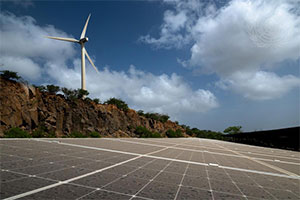 Renewable Energy in Cabo Verde. Credit: UN Photo/Mark Garten
A green economy is an economic model that aims to reduce environmental risks and build a sustainable future. Many of the UN SDGs seek to facilitate a green economy, such as ensuring access to affordable and reliable clean energy, building sustainable cities and communities, and implementing urgent action to combat climate change. Various key negotiations have strived to achieve a green economy, such as the Green New Deal and the Inflation Act of 2022. COP30, held in Belém, Brazil in 2025, agreed to mobilize $1.3 trillion annually for climate action and launched the Belém Mission to 1.5°C. However, the conference was not able to develop a fossil fuel reduction roadmap. Recent years have witnessed a sharp transformation in the geopolitical landscape of international sustainability cooperation. In March 2025, the United States stepped back from formal multilateral support for the SDGs, while China is on the rise as an international leader in renewable energy production. The actions of these global powers may shape shifting alliances on environmental governance. IPS is dedicated to sharing timely news on international developments in building a sustainable future.

The Week with IPS

NEXT STOP - SDGs
Tracking global progress towards a sustainable world
Tracking global progress towards a sustainable world
