Languages
Thursday, October 29, 2026



News and Views from the Global South
Labour

Coal: Burning Up Australia’s Future
With less than a year to go before the United Nation’s annual climate change meeting scheduled to take place in Paris in November 2015, citizens and civil society groups are pushing their elected leaders to take stock of national commitments to lower carbon emissions in a bid to cap runaway global warming.
From the Mountains to the Sea, Timorese Women Fight for More
In Timor-Leste, the gap between rich and poor is most keenly felt by rural women and children. But while women are working hard to help rebuild Timor-Leste, their contributions are not always recognised, in a country where men’s narratives still heavily dominate.
World Misses Its Potential by Excluding 50 Percent of Its People
The meeting is billed as one of the biggest single gatherings of women activists under one roof.
Opinion: Let’s Grant Women Land Rights and Power Our Future
Women are not only the world’s primary food producers. They are hardworking and innovative and, they invest far more of their earnings in their families than men. But most lack the single most important asset for accessing investment resources – land rights.
Opinion: It’s Time to Step It Up for Gender Equality
If we look at the headlines or the latest horrifying YouTube clip, Mar. 8 – International Women’s Day – may seem a bad time to celebrate equality for women.
Farm Projects Boost Bangladeshi Women, Children
Women in Bangladesh are carving healthier, wealthier futures for themselves and their children – and they have chicken eggs and pineapples to thank.
Tobacco Workers in Cuba Dubious About Opening of U.S. Market
“We have to wait and see,” “There isn’t a lot of talk about it,” are the responses from tobacco workers in this rural area in western Cuba when asked about the prospect of an opening of the U.S. market to Cuban cigars.
Opinion: Goals for Gender Equality Are Not a ‘Wish List’ – They Are a ‘To Do List’
This weekend, at the invitation of President Michelle Bachelet and myself, women leaders from across the world are meeting in Santiago de Chile. We will applaud their achievements. We will remind ourselves of their contributions. And we will chart a way forward to correct the historical record. History has not been fair to women – but then, women usually didn’t write it.
Rousseff’s Brazil – No Country for the Landless
In Brazil, one of the countries with the highest concentration of land ownership in the world, some 200,000 peasant farmers still have no plot of their own to farm – a problem that the first administration of President Dilma Rousseff did little to resolve.
Better to Die at Sea, than Languish in Poverty
Weerasinghearachilage Ruwan Rangana had it all planned out last year in September: the big break that would change his life and those of his extended family had finally arrived.
Mega-Cities, Mortality and Migration
As the international community marks the 70th anniversary of the founding of the United Nations, one question worthy of some reflection is: Is world population better or worse off demographically since the establishment of the U.N.?
At the Margins of a Hot War, Somalis Are ‘Hanging on by a Thread’
After twin suicide bombings at a popular Mogadishu hotel last week that killed 25 and wounded 40, news reporters were seen swarming through the city, spotlighting the victims, the assassins, the motives and the official response.
Analysis: Economic Growth Is Not Enough
Recent new data show a worrying picture of Latin America and the Caribbean. Income poverty reduction has stagnated and the number of poor has risen — for the first time in a decade — according to recent figures from the Economic Commission for Latin America and the Caribbean.
Deadly Asbestos Still Costing Lives
“I would get asbestos in my mouth, spit it out and carry on working,” said 52-year-old Francisco Padilla. Exposure to this deadly mineral fibre over most of his working life has resulted in cancer and the removal of his left lung, the lung lining and part of his diaphragm.
Maimed by Conflict, Forgotten by Peace: Life Through the Eyes of the War-Disabled
It is a hot, steamy day in Sri Lanka’s northwestern Mannar District. Mid-day temperatures are reaching 34 degrees Celsius, and the tarred road is practically melting under the sun.
Millennium Development Goals: A Mixed Report Card for India
Despite being one of the world's fastest expanding economies, projected to clock seven-percent GDP growth in 2017, India – a nation of 1.2 billion – is trailing behind on many vital social development indices while also hosting one-fourth of the world's poor.
Latin American Migrants Suffer Prejudice in Their Own Region
In the movie “A Day Without a Mexican“, the mysterious disappearance of all Mexicans brings the state of California to a halt. Would the same thing happen in some Latin American countries if immigrants from neighbouring countries, who suffer the same kind of discrimination, went missing?
Getting Bang for the Buck on New Development Goals
Right now, the United Nations is negotiating one of the world’s potentially most powerful policy documents. It can influence trillions of dollars, pull hundreds of millions out of poverty and hunger, reduce violence and improve education — essentially make the world a better place. But much depends on this being done well.
Warming, Wildfires and Worries
World leaders from government, finance, business, science and civil society are attempting to negotiate a legally binding and universal agreement on climate change at the upcoming 21st United Nations Climate Change Conference being convened in Paris in December.
U.N. Climate Talks Advance Link Between Gender and Climate Change
A week of climate negotiations in Geneva, Switzerland Feb. 8-13 are setting the stage for what promises to be a busy year. In order to reach an agreement in Paris by December, negotiators will have to climb a mountain of contentious issues which continue to overshadow the talks.
Women Pick Up the Slack as Fishing Declines on India’s Southern Coasts
Geeta Selvaraj and a few other women take turns to prepare meals with just one large gas cooker in a tiny shop.« Previous Page — Next Page »





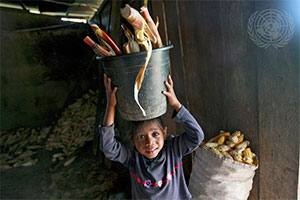 Timorese Girl with Fresh-Picked Corn. Credit: UN Photo/Martine Perret
A global common denominator is the need for a decent job. The economic realities of each country determine just how difficult it is to find one. Despite the labour movement's achievements, serious challenges persist: gender discrimination, child labour, worker migration, the digital divide and AI automation, evaporating pensions, unsafe workplaces, corporate pressure against union organising, negative impacts of trade agreements, and the precariousness of informal employment. The 2025 UN SDG Report identifies jobs and social protections as one of the six priority areas requiring urgent action, with progress either stalled or reversing in many developing nations.
In recent years, the fight to protect labour equality has taken on new dimensions with the rise of Environmental, Social and Governance standards. With the Social aspect aiming to promote equality and human rights, ESG principles have strengthened labour advocacy within corporate and governmental regulatory landscapes. In particular, ESG has become much more institutionalized in emerging economies such as Brazil and China. IPS follows the world’s workers as they confront these challenges - their setbacks and their successes.

The Week with IPS

NEXT STOP - SDGs
Tracking global progress towards a sustainable world
Tracking global progress towards a sustainable world
