Languages
Monday, November 9, 2026



News and Views from the Global South
Active Citizens

New Push for U.S. to Ratify Major Women’s Treaty
The United States continues to be in the dubious company of six countries that have either refused or are reluctant to ratify the landmark U.N. Convention on the Elimination of All Forms of Discrimination Against Women (CEDAW).
Abandoning Nuclear Weapons – Lessons from South Africa
Not many nice things can be said about the apartheid regime in South Africa. It was racist, violent in the brutal oppression of many of its own citizens, and was despised around the world.
Executions Elicit Fears of Authoritarianism
Taiwanese activists and human rights advocates ushered in the New Year with a push to prevent a return to authoritarianism and defend procedural justice for death row prisoners in the wake of six executions just before Christmas.
Historic Mapuche Land Conflict Flares Up
A string of attacks in the southern Chilean region of Araucanía, where native Mapuche people are struggling for their land rights, puts the spotlight squarely on what analysts call the "supine ignorance" displayed by authorities about the country's history.
Pacific Island Wakes Up to Threat of Oil Spills
Coral reefs and marine ecosystems in the Milne Bay Province of the Pacific Island nation of Papua New Guinea are at serious risk of long-term environmental damage. The reason: an oil spill from a ship that ran aground on a reef on Kwaiawata Island on Christmas Eve, and authorities’ long delay in mobilising an appropriate response to the accident.
Villagers Wail Against Nuclear Power
Mahalakshmi, a housewife married to a farmer, is afraid for her family’s future. The fifty-two-year-old woman is also frustrated that Indian authorities have "betrayed" poor villagers.
Yemeni Women Struggle to Step Forward
Yemeni women have played an integral role in the protests against ex-President Ali Abdullah Saleh’s 33-year regime last year. But despite the country’s upcoming political ‘National Dialogue’ - brokered by Gulf Cooperation Council (GCC) countries and intended to bring together a cross-section of Yemeni constituencies - females still face a wall of discriminatory laws and practices, and a status quo willing to enforce them.
OP-ED: The Arab Spring at Two: What Lessons Should We Learn?
As the Arab Spring enters its third year, new Arab democracies and the international community should reflect on several critical lessons from the past two years.New Feminism Tears Down Walls in Brazil
Anarkia Boladona has turned the streets of Brazil into billboards against domestic violence. As a self-titled feminist political graffiti artist, she represents a new trend in women’s rights that seeks less academic and more daring and popular avenues of expression.
OP-ED: Climate Inaction Is a Clear Failure of Democracy
Around the world, 2012 was the year of extreme weather, when we unequivocally learned that the fossil fuel energy that powers our societies is destroying them. Accepting this reality is the biggest challenge of the brand new year.
Paediatricians for a Healthy Environment
A group of Argentine paediatricians has been combining work on environmental protection and child health for more than 10 years. It appears a basic principle to apply, but the task is turning out to be increasingly challenging and complex.
Mystical Islam Deters Fundamentalism
Indonesia, the world's most populous Muslim-majority country, has found a deterrent to Islamic fundamentalists: they dress conservatively, sport short beards and Islamic caps and emulate the ways of the Prophet Muhammad.
Q&A: Global Ban Another Tool in the Fight Against FGM
For the estimated 140 million girls and women living with the consequences of Female Genital Mutilation (FGM), it is already too late. But since a global ban on FGM was passed at the end of last year, activists hope many more will now escape this brutal practice.
Bought, Sold and Abused in Yemen
Twenty-one-year-old Aisha clings to her two children as she recounts her tale of horror. Growing up in the Somali capital Mogadishu, she fell in love and bore a child out of wedlock four years ago. When her family threatened her life for destroying her ‘honour’, Aisha escaped.
Between Drought and Floods – A Year of Extremes in Sri Lanka
Wild elephants are usually the primary attraction in the remote shrub jungles of Udawalawe, about 180 kilometres southeast of Sri Lanka’s capital Colombo. But this Christmas season, the massive Udawalawe dam stole the limelight from the lumbering beasts.
Bicycles No Longer Mere Recreation in Argentine Capital
A programme launched in Buenos Aires three years ago to encourage the use of bicycles has already brought results: the use of this environment-friendly means of transport has increased fivefold in the Argentine capital.Thai-EU FTA Raises Alarm for People With AIDS
Days before leaders of the European Union (EU) arrived in Norway to collect this year’s Nobel Peace prize, Thai public health activists sent a letter to the northern powerhouse, warning that the EU’s 2012 accolades face a credibility test in this Southeast Asian country.
Renovating an Embattled City
Every day, Anas Maraka sees his family’s home, but can’t go inside. “It’s hardest for my grandfather,” said Maraka, referring to the house overlooking Shuhada Street, once the central marketplace in Hebron’s old city.
Reviving Family Farming in Angola, Carrot by Carrot
"We never used to eat carrots, but now we like them," said Rebeca Soba, admiring her vegetable garden, an island of diversity in the midst of a vast sugarcane plantation. Vegetable gardening has been introduced at the Capanda Agroindustrial Pole (PAC) as a source of income for local small farmers.
Q&A: Depending on Democracy to Deliver Sustainable Development
"Accelerating environmental pressures and growing economic inequality are triggering huge social changes around the world, putting existing democracies to the test,” Halina Ward, director of the London-based Foundation for Democracy and Sustainable Development, tells IPS.
Fear of Rape Stalks Indian Women
While a 23-year-old woman battles for life in a New Delhi hospital after she was gang raped and brutalised on a moving bus in India's prosperous national capital earlier this month, women across the nation say they live in constant fear of sexual assault.« Previous Page — Next Page »





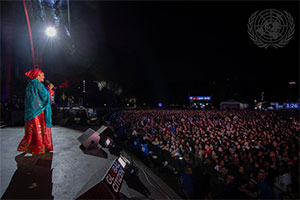 Global Citizen Festival in New York. Credit: UN Photo/Eskinder Debebe
Active citizens are committed to social change because they know that it is achievable. However, major political challenges face active citizens across the world. For example, in authoritarian regimes in Latin America where the hegemonic party has been in power for decades on end, protestors and human rights activists face enormous repression and struggle to materialize their advocacy into concrete results. The same can be said for Africans, where a shift towards elected government in recent decades has yet to translate into an effective voice in decision-making. Now, the Strengthening Citizen Demand for Good Governance, which uses evidence-based approaches – funded by DFID's Governance and Transparency Fund – seeks to raise their voices.
In 2025, the CIVICUS Monitor’s People Power Under Attack report revealed that civic freedoms are severely limited in 122 of 198 countries and territories, and only 7.2% of the global population now lives in countries where civic space is open. Through partnership with the Overseas Development Institute (ODI) and CIVICUS, IPS reporters across the continent will seek to define the extent and limits of state capability, government accountability and the responsiveness of leaders to the needs of citizens.

The Week with IPS

NEXT STOP - SDGs
Tracking global progress towards a sustainable world
Tracking global progress towards a sustainable world
