Languages
Wednesday, October 7, 2026



News and Views from the Global South
Energy

Doubts about Chile’s Green Hydrogen Boom
In Magallanes, Chile's southernmost region, doubts and questions are being raised about the environmental impact of turning this area into the world's leading producer of green hydrogen.
Biomethane from Garbage: Turning a Climate Enemy into Clean Energy – VIDEO
 Garbage that has accumulated since 1991 in the two landfills in the municipality of Caucaia has become a biomethane deposit that supplies industrial and commercial companies, thermoelectric plants and homes in Ceará, a state in northeastern Brazil.
Cuban Innovator Uses Sunlight to Create a Model Sustainable Space
After making a model for a solar heater, installing solar panels and creating a device to dehydrate food with the help of the sun, Félix Morffi is turning his home into a space for the production and promotion of renewable energies in Cuba.
The Swedish Elections: A Victory for Populism
After general elections on the 12th September, Sweden is on the threshold of a new era. The Sweden Democrats (SD) won almost 21 percent of the votes and thus became the largest in a bloc of right-wing parties that now have a collective majority in the parliament. A nation that for a long time prided itself of being a beacon of tolerance and openness will now experience a historical transformation. The Sweden Democrats was once founded by Nazi sympathisers and for decades shunned by mainstream politicians. However, SD has now tipped the political scale in a country previously known for its stable and predictable politics, and some of the party’s former foes are now willing to co-rule with them.
Mexico’s Electric Mobility, Stuck in Fossil Fuel Traffic
The Mexico City government began testing an elevated route for electric buses with great fanfare on Sept. 11, in a bid to promote more sustainable transport. The initiative is part of an incipient promotion of electromobility in the country, amidst pro-fossil fuel energy policies.
USA and Russia: Pursuit of Global Hegemony
Can a pitiless, offensive war waged against a sovereign state be justified? In my opinion the answer is an unequivocal “No!”. Ukraine has the right to defend itself against Russia’s reckless and extremely destructive invasion and EU’s support to a neighbouring country attacked by a superior enemy is definitely correct. However, several Latin American intellectuals and leaders are willing to accept Putin’s narrative, instead of Zelensky’s, namely that the war in Ukraine is actually a war between Russia and USA, which by stalling Russia’s and China’s ambitions intends to maintain its supremacy as a superpower, while using Ukraine as a pawn in its power game.
Great Wind and Solar Potential Boosts Green Hydrogen in Northern Brazil
Brazil could become a world leader in the production of green hydrogen, and the northeastern state of Ceará has anticipated this future role by making the port of Pecém, with its export processing zone, a hub for this energy source.
United We Stand to Achieve Sustainable Development
The world today faces a future that is in peril. Our challenges have become more complex and interconnected, as we see the impacts of the COVID-19 pandemic, an uneven economic recovery, a climate emergency, growing inequalities, and an increase in conflicts globally. This year also marks a grim milestone, with over 100 million people forcibly displaced.
1980s’ Redux? New context, Old Threats
As rich countries raise interest rates in double-edged efforts to address inflation, developing countries are struggling to cope with slowdowns, inflation, higher interest rates and other costs, plus growing debt distress.
Biomethane, the Energy that Cleans Garbage in Brazil
The increasing productivity with which humankind generates waste has gained at least one sustainable counterpart: the extraction of biogas from landfills, a growing activity in Brazil.
Africa Should Trade its Carbon Credits to Fund Renewable Energy – UNECA
Africa needs to trade in carbon credits to reduce greenhouse gas emissions, finance the transition to renewable energy, and boost economic development, the United Nations Economic Commission for Africa (UNECA) says.
A Tale of the Spanish Neckties and Other Made-in-Europe Things
Shortly before the 25 August approval by the Spanish Parliament of the government’s plan to save energy, the country’s right and far-right opposition parties revived their debate about an earlier suggestion of not wearing neckties in the Spanish Congress and Senate and other official institutions.
How France Underdevelops Africa
Most sub-Saharan African French colonies got formal independence in the 1960s. But their economies have progressed little, leaving most people in poverty, and generally worse off than in other post-colonial African economies. Decolonization? Pre-Second World War colonial monetary arrangements were consolidated into the Colonies Françaises d’Afrique (CFA) franc zone set up on 26 December 1945. Decolonization became inevitable after France’s defeat at Dien Bien Phu in 1954 and withdrawal from Algeria less than a decade later.
Argentina Seeks Elusive Investment to Fully Exploit Shale Gas
Argentina, which has one of the largest unconventional hydrocarbon deposits in the world, has been forced to import gas for 6.6 billion dollars so far this year.
Indian Workers Defend Their Steel with Their Lives
The long and distant epoch of pre-history, dated to the time before the start of the Common Era, is conventionally divided into three periods: the Stone Age, the Bronze Age, and the Iron Age. Subsequently, in the era of written history, we generally have not relied upon specific metals or minerals to define our periods. Too many metals and minerals, harnessed by new production techniques and new labour patterns, have contributed to our immense capacity to generate large surpluses. There is the Age of Industry but not, for instance, the Age of Steel, the core metal of our period.
There’s no Stopping Renewable Power in Chile, but Community Energy Is Not Taking Off
Renewable energies, especially solar and wind power, are growing inexorably in Chile, driven by large companies. But community generation of alternative energy is not taking off, despite a law promoting it.
How NOT to Win Friends and Influence People
After four years of Trump’s ‘America first’ isolationism, US President Joe Biden announced “America is back”. His White House has since tried to find allies against China and Russia. But it has not found many, especially in the Global South. His summit with Southeast Asian leaders was well attended, but promised little. Worse, his Summit of the Americas revealed fading US influence in its long-time backyard.
Biofuels Slow Down Electric Vehicles in Brazil
Brazil celebrated 100,000 electric vehicles in circulation in late July, but this is a drop in the ocean compared to the 46 million combustion vehicles registered in the country and in contrast with the pace of the phasing out of oil in the world's automotive industry.
Stagflation: From Tragedy to Farce
Half a century after the 1970s’ stagflation, economies are slowing, even contracting, as prices rise again. Thus, the World Bank warns, “Surging energy and food prices heighten the risk of a prolonged period of global stagflation reminiscent of the 1970s.” In March, Reuters reported, “With surging oil prices, concerns about the hawkishness of the Federal Reserve and fears of Russian aggression in Eastern Europe, the mood on Wall Street feels like a return to the 1970s”.
Climate Change Conclusion: Time for Bold Action
With climate change bringing about increasing numbers of human deaths and untold suffering, and rising economic, social, and environmental consequences worldwide, it’s time for governments to take bold action to address the climate change emergency.
Biogas Production Awaits Greater Incentives in Cuba
Standing in front of a blue flame on her stove, getting ready to brew coffee, Mayra Rojas says the biodigester built in the backyard of her home in western Cuba has become a key part of her daily life and a pillar of her family's well-being.« Previous Page — Next Page »





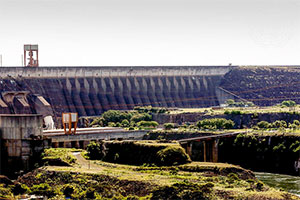 UN Power Plant, Paraguay. Credit: UN Photo/Evan Schneider
Energy has posed a great challenge for economies around the world. As global energy consumption skyrockets throughout the years, so does the need for sustainable solutions. The Sustainable Development Goals are essential in providing people with access to safe, affordable, and sustainable energy sources that minimize harm on the planet. Progress towards these goals opens the door for an advancement in modernization for communities on a global level and allows for a potential mitigation of tensions between nations.
The UN’s Summit of the Future in 2024 offered new initiatives that are being taken to achieve these goals, including a decreased reliance on fossil fuels, a switch to renewable energy sources, and improved climate financing.
IPS is well positioned to provide relevant, insightful, and compelling analysis of recent updates and measures being taken around the world to achieve a cleaner future.

The Week with IPS

NEXT STOP - SDGs
Tracking global progress towards a sustainable world
Tracking global progress towards a sustainable world
