Languages
Wednesday, November 18, 2026



News and Views from the Global South
Poverty & SDGs

Q&A: Migration Now a Key Part of the Global Economy
As international migration continues to grow in scope, complexity and impact, effectively managing it has steadily moved up on the agenda of the international community.
U.N. Chief Fires Up Private Investment for Global Energy Solutions
Following a lukewarm outcome of the Rio+20 sustainable development negotiations in June, U.N. Secretary-General Ban Ki-moon is moving full-steam ahead on a new initiative aimed at leveraging public-private partnerships to bring modern energy to over one billion people by 2030.
The Long Road to a Home of One’s Own in Cuba
“The most important thing for Cubans is their home,” says Raimundo Pérez, a real estate broker who is familiar with the travails of finding housing, despite the latest incentives made available by the Cuban government.
New Roadmap for NGOs in Haiti Aims to “Weed Out Bad Apples”
Haitian Prime Minister Laurent Lamothe and representatives from more than 50 non-governmental organisations, including actor-activist Sean Penn, met in New York on Monday to present a new roadmap for humanitarian aid in the country.
Stevia, a Flourishing Business in Spain
On a parcel of land a few kilometres outside the southern Spanish city of Málaga, unemployed activists are growing 2,000 seedlings of stevia, a plant used by the Guaraní indigenous people for centuries as a natural sweetener that is awakening ever greater interest in Spain.
Keeping Girls in School in Uganda
Three years ago, after Irene Kamyuka finished her sixth year of primary school in Uganda, her father ran short of money. With four siblings ahead of her in school, Kamyuka’s father told her she would have to drop out until his finances turned around.
Vaccines Get Past Taliban, Finally
Over thirty thousand children in the remote Tirah area of the Khyber Agency, part of the Federally Administered Tribal Areas (FATA) in Northern Pakistan, have waited four years for protection from polio, a viral disease that is sometimes referred to as ‘infantile paralysis’ due to its crippling effects on children.
Brazil Tries Natural Method to Eradicate Dengue
Scientists in Brazil announced the start of experiments with an “innocuous, self-sustainable” method to fight transmission of the dengue virus by the Aedes aegypti mosquito, using a bacterium that is naturally occurring in nature.
Strained East-West Relations Dominate General Assembly Opening
Addressing the 67th General Assembly at the United Nations in New York Tuesday, U.S. President Barack Obama accused the Iranian government of propping up the dictatorship in Syria and supporting terrorist groups abroad.
Giving Women Farmers the Tools to Prevent Food Insecurity
If women had equal access to productive farming resources, they could increase their yields by 20 to 30 percent and potentially raise total agricultural output in developing countries by 2.5 to four percent.
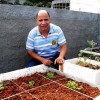
Urban Agriculture Sprouts in Brazil’s Favelas
You do not need to live in the countryside to grow vegetables, as hundreds of thousands of people involved in urban agriculture from Havana to Buenos Aires know very well. Now they are being joined by residents of Rio de Janeiro’s “favelas”.
Q&A: Guatemala’s Bold Attorney General Makes a Dent in Impunity
Since Claudia Paz y Paz Bailey became attorney general in Guatemala in 2010, a string of crimes involving military personnel who fought leftwing guerrillas, drug traffickers and organised crime have been cleared up.Nobel Laureate Calls for Armed Intervention in Nigeria
On the International Day of Peace, Nobel Prize winner Wole Soyinka visited the United Nations - and called for armed intervention against the terrorist group Boko Haram in his home country of Nigeria.Rural Mexican Communities Rich in Resources, Poor in Capital
The La Ventanilla community in the southern Mexican state of Oaxaca has not given up in the face of devastating hurricanes, but has organised to protect mangroves and animal species like the Olive Ridley sea turtle.
Maldives Talks Condoms
For an orthodox Islamic country, the Maldives has made remarkable progress in halting the spread of HIV in the Indian Ocean archipelago through bold awareness programmes and the distribution of condoms.
Cuba’s Reforms Shift Focus to Training Skilled Workers
His carpenter’s certificate has made Antonio Tejero into a passionate champion of the trades, because, he says, he works “directly for society.” That attitude is in line with the government’s plan to train more technicians and skilled workers to give a boost to the economy.U.N. Report Chastises U.S. for Status of Native Population
A top United Nations official has presented the first ever international investigation into the situation of indigenous peoples in the United States, urging the adoption of new policies and mechanisms to “address persistent deep-seeded problems related to historical wrongs, failed policies of the past and continuing systemic barriers”.
Human Rights Education Shows Its Potential
The impact of human rights education, a rising star, is highlighted in a short documentary sponsored by United Nations experts and civil society.
As Aid Shrinks, U.N.’s Development Goals Under Threat
If the developing world fails to meet the targets set in the eight Millennium Development Goals (MDGs) – relating mostly to poverty, hunger, education, health care, gender empowerment and the environment – the primary blame for the failure would be on Western donors who have reneged on their aid commitments, according to a new report released here.
Money for Salt: How the Country of the Young Is Failing Its Elderly
Carolina Poalo strikes the dry earth over and over with her hoe, her frail body bent almost double. She is determined to begin planting. During the long, dry season in Mozambique, she and her two young grandchildren have eaten little but cassava leaves.
Uganda’s ‘Haunted’ Children Slow to Receive Medical Help
On a wet earth littered with fresh fruit from a large mango tree in Tumangu village in northern Uganda, Betty Olana (42) sits on a papyrus mat watching over four emaciated children infected by the mysterious nodding syndrome that leaves victims mentally challenged and nodding repeatedly when they see food or cold water.« Previous Page — Next Page »


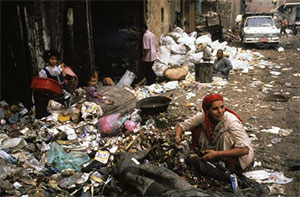 Romani people in Cairo, Egypt, forage through trash. Credit: UN Photo/Armineh Johannes
In 2015, the United Nations adopted the Sustainable Development Goals (SDGs) in an effort to promote “peace and prosperity for people and the planet.” To achieve that goal, it is essential to provide equal opportunities and access to basic services to all people. The 2025 UN SDG Report found that 35% of the 169 SDG targets are on track or making moderate progress, while 18% have reversed compared to the 2025 baseline. One in ten people still live in extreme poverty, one in eleven experience food insecurity, and over 1.1 billion people live in slums without access to clean water and sanitation. It is imperative to acknowledge the societal, technological, economic, and political issues that sustain poverty in countries around the world. Eradicating poverty will require significant frameworks in policy and governance on a national and international scale to ensure that all people will have equal access to basic services and economic opportunities by 2030. Furthermore, a dramatic reduction of United States foreign aid in 2025, including the termination of 83% of USAID programmes, threatens to erode years of fragile development gains.
Throughout the world, violent conflict and natural disasters also contribute to extreme poverty. The complete destruction of infrastructure and blockage of aid has significantly impoverished Palestine since October 7th. The destructive impact of Hurricane Maria in Puerto Rico left $91 billion in damage. An inadequate US government response also revealed significant and enduring questions within the issue of mitigating poverty: how do we rebuild infrastructure after its destruction? How do we restimulate economic development and bring in financial aid after disasters? Similar questions have been raised in the realm of regional cooperation, as devastating floods have wrecked hundreds of thousands of homes across multiple Southeast Asian nations in the past few years. Furthermore, the COVID-19 pandemic has greatly exacerbated the global poverty crisis, particularly in developing countries, setting back the United Nations goal of eradicating poverty by 2030.
IPS is committed to providing comprehensive features that focus on the persisting environmental, sociopolitical, and systemic issues that sustain poverty, and the steps taken worldwide towards poverty eradication.

The Week with IPS

NEXT STOP - SDGs
Tracking global progress towards a sustainable world
Tracking global progress towards a sustainable world

