Languages
Tuesday, November 17, 2026



News and Views from the Global South
Active Citizens

OP-ED: What We Owe Our Youth
On Wednesday, we kick off a three-day meeting in Mexico City to discuss how to boost the involvement of young people in politics and expand their role in consolidating democracy in Latin America and the Caribbean.
Local Money Sets Its Own Stamp
Bristol, the eighth most populous town in the UK, has launched a local currency - the Bristol Pound. That makes it one of the largest localities to embrace a complementary currency among more than 2,500 worldwide.
Communal Land Titling at a Standstill in Peru
The titling of the lands of indigenous and peasant communities has been at a practical standstill for two years, with many of the corresponding files lost or incomplete. But the promotion of foreign investment is moving full steam ahead in the same regions.
Purveyors of Death Flourish in Spain During Crisis
At the height of the economic and financial crisis, the Spanish government is promoting the export of weapons, creating concern among civil society organisations that say commercial interests are prevailing over the law and human rights.
Caged in the Great City
Ali Shuruf turns on the lights, that shine into a gaudy living room. Beyond the window, the dominant colour is uniformly grey: the house stands literally against a wall. Not just any wall – the infamous eight-metre cement wall separates Palestinians from Israelis.
Donors Urged to Tread Carefully in Myanmar
Foreign donors are rushing into Myanmar (formerly Burma), whose government has been pushing the right political buttons as part of its democratic reform process. But development planners and local activists caution that the best approach should still be ‘easy does it’.
Women Hit Hard by Natural Disasters
In the aftermath of a natural disaster, women are often the most vulnerable. Particularly in rural areas, women suffer disproportionately from inadequate shelter and poor sanitation facilities and are often tasked with rebuilding shattered homes.
Q&A: Disaster Resilience Starts with Grassroots Women
Women and girls can be powerful agents of change, but they are disproportionately affected by disasters because of social roles, discrimination and poverty.
Women Are the New ‘Emerging Market’
Empowering women in the business world is not only a smart political decision, but also makes good economic sense.
Brazil’s Gender Quota Law Off to Underwhelming Start
Brazil’s new law requiring that 30 percent of candidates must be women made a less than impressive debut in Sunday’s municipal elections, although female candidates for mayor made better headway than women running for town councils.
Rural Women in Peru Cope “Where Life Is Very Sad”
When the crops in her rural highlands community in southern Peru were covered with a thick layer of ice one night, Felícitas Quispe, 43, organised her neighbours to make an effort to keep people from starving to death.
Girls Determined to Fight Guns With Books
Shazia Begum, one of three girls injured in the attack on the Pakistani schoolgirl Malala Yousafzai says the Taliban had sought to silence a very influential schoolgirl.
Where Drugs Abound – and Syringes to Fight AIDS Are Scarce
In northern Mexico, one of the areas in the country hit hardest by drug trafficking, there are not enough syringes to protect intravenous drug users from HIV/AIDS and hepatitis.
Groups Rewarded in Their Fight for Fair Food
The Korean Women's Peasant Association won the 2012 Food Sovereignty Prize for its efforts on behalf of the survival of small-scale and ecologically sustainable farming in South Korea.Death Penalty Campaigners Worry About the Steps Back
Ten years of campaigning by the World Coalition against the Death Penalty have brought fruit: the number of countries that have abolished capital punishment in law or practice has gone up to 140. But some countries have resumed executions this year.
Co-operatives Hold Their Own in Free Market Jungle
Cooperatives may face an immense challenge in garnering broader public recognition among consumers, but when it comes to chasing growth, they haven’t held back.
Sendai Shares Big Lessons from the Great Quake
The debris of the devastated Arahama elementary school yielded two enduring lessons for its principal, Takao Kawamura, in the months after the massive 9.0-magnitude earthquake and tsunami that hit Japan’s north-east coastland on Mar. 11, 2011.

Garifuna Women, Custodians of Culture and the Environment in Honduras
Hurricane Mitch, which devastated Honduras 14 years ago, prompted a group of Garifuna women to start organising, to help the people in greatest need of assistance.
Greek State on Life Support
Like a person on life support whose vital functions are failing, the Greek economy is slowly but surely shutting down as radiation from the so-called ‘austerity plan’ erodes public institutions.
Pangolin Trade Betrays Apathy for Biodiversity
Conservationists see the decimation of pangolins (scaly anteaters) in Pakistan as a sign of the callousness with which this country’s rich biodiversity is being traded away for commercial gain.Guatemala under Pressure to Investigate Shooting of Native Protesters
The deaths of eight indigenous demonstrators taking part in a protest against the Guatemalan government in the southwestern province of Totonicapán have provoked outrage within the country and abroad. The protesters accuse the army of shooting into the crowd.« Previous Page — Next Page »


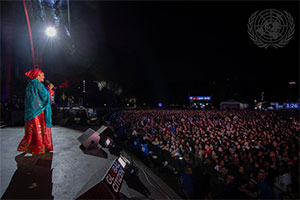 Global Citizen Festival in New York. Credit: UN Photo/Eskinder Debebe
Active citizens are committed to social change because they know that it is achievable. However, major political challenges face active citizens across the world. For example, in authoritarian regimes in Latin America where the hegemonic party has been in power for decades on end, protestors and human rights activists face enormous repression and struggle to materialize their advocacy into concrete results. The same can be said for Africans, where a shift towards elected government in recent decades has yet to translate into an effective voice in decision-making. Now, the Strengthening Citizen Demand for Good Governance, which uses evidence-based approaches – funded by DFID's Governance and Transparency Fund – seeks to raise their voices.
In 2025, the CIVICUS Monitor’s People Power Under Attack report revealed that civic freedoms are severely limited in 122 of 198 countries and territories, and only 7.2% of the global population now lives in countries where civic space is open. Through partnership with the Overseas Development Institute (ODI) and CIVICUS, IPS reporters across the continent will seek to define the extent and limits of state capability, government accountability and the responsiveness of leaders to the needs of citizens.

The Week with IPS

NEXT STOP - SDGs
Tracking global progress towards a sustainable world
Tracking global progress towards a sustainable world
