Languages
Tuesday, November 17, 2026



News and Views from the Global South
Active Citizens
Equal Parts Tolerance and Extremism in Indonesian Islam
Scattered across 17,000 islands on the Indian and Pacific oceans, the world's largest Muslim country has found its own blend of Islam: equal parts religion, secularism and contradictions.
Swapping Trash for Fresh Produce in Mexico City
Isabel Becerril has come with some friends to the “barter market” in the Mexican capital, to exchange 40 kgs of recyclable refuse for fresh produce, sweets and plants. “This is the first time I have come here, and I like it,” the university student tells IPS, with her ecological bag in hand.
Elderly Find Few Places to Call Home
Mr. Jayakumar (73), a philanthropic bachelor hailing from a prosperous industrial family in the southern Indian state of Karnataka, decided at the age of 70 that it was time to settle down.
Cuban Intellectuals Discuss the Transformation of the Public Sphere
On discussion panels, by email and in the blogosphere, Cuban intellectuals are speaking out to bring a critical perspective and propose roads forward to national development. And they increasingly seem to be including the transformation of public space as one of their goals.
How a Gay Rights Maverick Helped Topple Iceland’s Govt
By the time the political climate in Iceland was ripe for the Cutlery Revolution, Hörður Torfason was already well practiced at stirring things up.
Native Peoples Take on Threadbare Stereotypes
With the International Day of the World’s Indigenous Peoples coming up on Thursday, native communities are increasingly using media to challenge a legacy of stereotypes.
Ahmadis Lose Hope This Ramadan
As millions around the world enter the third week of the Ramadan fast, the fraternity that typically unites Muslims during the holy month does not extend to Pakistan’s Ahmadi community, which is facing worse persecution than ever before.
Awareness of Climate Change Risks Low in Dominican Republic
One of the major difficulties to overcome in climate change adaptation policies in the Dominican Republic is society’s low awareness of the risks, even though this Caribbean island nation is seriously exposed to the impacts of the phenomenon.
Climate-Battered South Asia Looks to Rio+20 Formula
Far-flung South Asian communities, from the high Himalayan slopes to the Indian Ocean coasts, united in the face of extreme and uncertain weather, continue to hold on to the hope that the Rio+20 focus on disaster risk reduction (DRR) will positively influence national policies.
Mexican Communities Fight Mini-Dams
Small-scale hydroelectric dams with a capacity of under 30 MW are seen by the authorities in Mexico as an important alternative for generating energy. But local communities reject them on the argument that they would cause social, economic and environmental damages.
An Unconventional Road to Peace
In a country where talk of a ceasefire brings representatives from 11 different armed ethnic groups to the table, Myanmar’s chief peace negotiator, Railway Minister Aung Min, is experimenting with an unusual solution to decades of separatist struggles.
Salvadoran Civil Society Groups Opposed to Carbon Credit Plan
Civil society organisations are asking the World Bank to reject the Salvadoran government's proposal to join a programme for reducing greenhouse gas emissions linked to deforestation, on the argument that it will actually harm the environment.
Investigation Exposes Cruelty at Foie Gras Farms
Roasted foie gras fillet, with fresh chestnuts and soymilk skin. This dish from Mugaritz, considered the third-best restaurant in the world, sounds exotic. But how this "delicacy" - foie gras means "fat liver" - is produced and at what cost have been unmasked in an investigation led by Animal Equality.
Human Right to Water and Sanitation Remains a Political Mirage
When the 193-member General Assembly, the U.N.'s highest policy-making body, declared water and sanitation a basic human right back in July 2010, the adoption of that divisive resolution was hailed by many as a "historic" achievement.Mainstream Rhetoric on Nuclear Power Far From Reality
The catastrophe following the meltdown of the Fukushima Daiichi nuclear power reactor in March 2011 has turned the old debate on nuclear power into a war of words between international agencies and independent experts with diametrically opposed views.
India Drowning in Waste, Experts Warn
Almitra Patel, a civil engineer by qualification, says she was first alerted to India’s huge problem of inadequate waste disposal when she noticed that the frogs in the marshlands near her farmhouse, on the city’s outskirts, had stopped croaking.
UNESCO Protection Crucial – and Controversial
It took six years for a dedicated team of scientists from the Wildlife Institute of India, wildlife officials from six Indian states and officials from the federal ministry to secure international protection for one of India’s most precious biological reserves.
Groups Vow to Fight Arctic Drilling
Many environmental groups are concerned over a possible extension of drilling expeditions in the Arctic, as oil companies, including Royal Dutch Shell, are set to begin drilling in the region as early as this week.
U.S., Russia and China Stick to Their Guns
The protracted negotiations on an Arms Trade Treaty (ATT) with the ambitious aim of eradicating the illicit trade in conventional arms hit a deadlock Friday at United Nations as Washington, Moscow and Beijing required "more time" after six years of preparatory meetings.
Native Canadians Fear Mining Boom in “Ring of Fire”
With accusations that Canadian resource companies and government officials are disregarding the need for indigenous consent in development projects, First Nations leaders have lashed out by approving a resolution calling for a moratorium on mining development in the so-called Ring of Fire until proper consultation begins.
Profiting from Sustainable Forests on Communal Land in Mexico
Mario Guzmán plans to start cutting down trees again in August and September, the last months of the rainy season. “Now the roads are impassable, and the trucks can’t get in to haul out the timber,” the Mexican farmer, whose community is sustainably managing its forests, told IPS.« Previous Page — Next Page »


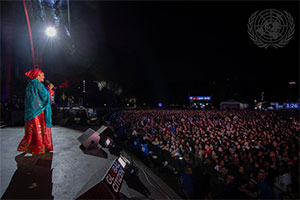 Global Citizen Festival in New York. Credit: UN Photo/Eskinder Debebe
Active citizens are committed to social change because they know that it is achievable. However, major political challenges face active citizens across the world. For example, in authoritarian regimes in Latin America where the hegemonic party has been in power for decades on end, protestors and human rights activists face enormous repression and struggle to materialize their advocacy into concrete results. The same can be said for Africans, where a shift towards elected government in recent decades has yet to translate into an effective voice in decision-making. Now, the Strengthening Citizen Demand for Good Governance, which uses evidence-based approaches – funded by DFID's Governance and Transparency Fund – seeks to raise their voices.
In 2025, the CIVICUS Monitor’s People Power Under Attack report revealed that civic freedoms are severely limited in 122 of 198 countries and territories, and only 7.2% of the global population now lives in countries where civic space is open. Through partnership with the Overseas Development Institute (ODI) and CIVICUS, IPS reporters across the continent will seek to define the extent and limits of state capability, government accountability and the responsiveness of leaders to the needs of citizens.

The Week with IPS

NEXT STOP - SDGs
Tracking global progress towards a sustainable world
Tracking global progress towards a sustainable world
