Languages
Monday, November 9, 2026



News and Views from the Global South
Active Citizens

Cooperatives Cushion the Blows of Hunger
“One in eight people goes to sleep hungry every day,” according to the ‘State of Food Insecurity in the World 2012’, a document released annually by the Food and Agriculture Organisation (FAO).
Q&A: “There Is No National Boundary for Medical Care”
For millions of people in developing countries, having cataracts means permanently impaired vision or even blindness. While treatment can fix the problem, the cost is well beyond most sufferers' reach.
Gang Truce Can Break Down, Prevention Should Be Priority
El Salvador has managed to bring down one of the world’s highest murder rates thanks to a truce between gangs that was lauded by the United Nations as an example to be followed in other countries of Central America.
Palau Proves Sharks Worth More Alive Than Dead
Sharks have a safe haven the size of France, and the Republic of Palau that protects them is making millions of dollars from shark tourism.
The Face of Food Security Is Female
In a major endorsement for investment in women - the bulk of food growers in the developing world - United Nations Secretary General Ban Ki-moon said food security could not be achieved without women, and that the world's hungry also needed leaders to prioritise actions.
‘Urban Planning Must Factor in Biodiversity’
“With more than 60 percent of the world projected to be urban by 2030 why not prepare for it and build cities that include biodiversity preservation into planning?” asks Kobie Brand of ICLEI Local Governments for Sustainability in Cape Town, South Africa.
Violence Against Women Surging in India
As gender-based violence across India becomes more frequent, and more savage, increasing numbers of women are speaking out against the cruelty.
Shadow Over Aichi Biodiversity Targets
With negotiations to mobilise resources for preservation of biodiversity at a major United Nations conference going nowhere, the Group of 77 and China have hinted at possible suspension of the ‘Aichi targets’ under the Nagoya Protocol.
Internet Becomes Newest Victim of Repression in Kashmir
Fayaz Ahmad’s Faim Internet Café in the Sopore township of Indian Kashmir was booming until a year ago, when police entered his premises without warning and seized all his computers.
Women’s Groups Say Uruguay’s New Abortion Law Falls Short
The Uruguayan Congress passed a law Wednesday decriminalising abortion, making it one of the few countries in the region where abortion is allowed in cases other than rape, incest, malformation of the fetus or danger to the mother’s life. But activists who backed the bill are not pleased with modifications introduced in the final version.
Communities Organise to Confront Climate Change in El Salvador
Armed with chainsaws, machetes and shovels, local residents of El Salvador’s Lower Lempa River Basin, near the Pacific Ocean, are unblocking the flow of rivers and pruning the branches of trees on riverbanks to keep them from falling into the chocolate-colored water.
OP-ED: What We Owe Our Youth
On Wednesday, we kick off a three-day meeting in Mexico City to discuss how to boost the involvement of young people in politics and expand their role in consolidating democracy in Latin America and the Caribbean.
Local Money Sets Its Own Stamp
Bristol, the eighth most populous town in the UK, has launched a local currency - the Bristol Pound. That makes it one of the largest localities to embrace a complementary currency among more than 2,500 worldwide.
Communal Land Titling at a Standstill in Peru
The titling of the lands of indigenous and peasant communities has been at a practical standstill for two years, with many of the corresponding files lost or incomplete. But the promotion of foreign investment is moving full steam ahead in the same regions.
Purveyors of Death Flourish in Spain During Crisis
At the height of the economic and financial crisis, the Spanish government is promoting the export of weapons, creating concern among civil society organisations that say commercial interests are prevailing over the law and human rights.
Caged in the Great City
Ali Shuruf turns on the lights, that shine into a gaudy living room. Beyond the window, the dominant colour is uniformly grey: the house stands literally against a wall. Not just any wall – the infamous eight-metre cement wall separates Palestinians from Israelis.
Donors Urged to Tread Carefully in Myanmar
Foreign donors are rushing into Myanmar (formerly Burma), whose government has been pushing the right political buttons as part of its democratic reform process. But development planners and local activists caution that the best approach should still be ‘easy does it’.
Women Hit Hard by Natural Disasters
In the aftermath of a natural disaster, women are often the most vulnerable. Particularly in rural areas, women suffer disproportionately from inadequate shelter and poor sanitation facilities and are often tasked with rebuilding shattered homes.
Q&A: Disaster Resilience Starts with Grassroots Women
Women and girls can be powerful agents of change, but they are disproportionately affected by disasters because of social roles, discrimination and poverty.
Women Are the New ‘Emerging Market’
Empowering women in the business world is not only a smart political decision, but also makes good economic sense.
Brazil’s Gender Quota Law Off to Underwhelming Start
Brazil’s new law requiring that 30 percent of candidates must be women made a less than impressive debut in Sunday’s municipal elections, although female candidates for mayor made better headway than women running for town councils.« Previous Page — Next Page »





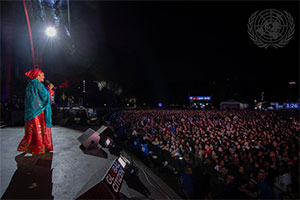 Global Citizen Festival in New York. Credit: UN Photo/Eskinder Debebe
Active citizens are committed to social change because they know that it is achievable. However, major political challenges face active citizens across the world. For example, in authoritarian regimes in Latin America where the hegemonic party has been in power for decades on end, protestors and human rights activists face enormous repression and struggle to materialize their advocacy into concrete results. The same can be said for Africans, where a shift towards elected government in recent decades has yet to translate into an effective voice in decision-making. Now, the Strengthening Citizen Demand for Good Governance, which uses evidence-based approaches – funded by DFID's Governance and Transparency Fund – seeks to raise their voices.
In 2025, the CIVICUS Monitor’s People Power Under Attack report revealed that civic freedoms are severely limited in 122 of 198 countries and territories, and only 7.2% of the global population now lives in countries where civic space is open. Through partnership with the Overseas Development Institute (ODI) and CIVICUS, IPS reporters across the continent will seek to define the extent and limits of state capability, government accountability and the responsiveness of leaders to the needs of citizens.

The Week with IPS

NEXT STOP - SDGs
Tracking global progress towards a sustainable world
Tracking global progress towards a sustainable world
