Languages
Wednesday, November 11, 2026



News and Views from the Global South
Active Citizens
Theatre with a Political Edge in Kazakhstan
A group of villagers is held in thrall by omnipotent rulers, who warn that misfortune will befall the inhabitants if they defy authorities. And then, one day, the emperor is revealed to have no clothes.
Mexican Communities Sue Pemex for Environmental Justice
Fed up with oil spills from facilities belonging to Mexico’s state oil company Pemex, residents of two communities in the southeastern state of Tabasco are taking the country’s largest company to court in a bid for compensation for damage to the environment and agriculture.
Climate Change Is Happening… So What?
Seven in 10 U.S. citizens believe climate change is real and happening now. Yet most have never even contacted a government official about the issue, let alone volunteered with an environmental organisation or taken other action.
Unravelling the Civil War Propaganda
Western fears of a civil war in Afghanistan are growing ahead of the scheduled pullout of international troops in 2014. However, experts here say the situation on the ground is not comparable to either 1988, when the Soviets withdrew from the country, or the mujahideen’s rise to power in 1992, which plunged the country into civil war.
Resource Management Central to Equitable Development
Trillions of dollars a year are being produced through extractive industries, but just a tiny percentage of this money is impacting on the lives of poor communities in developing countries, according to a first-of-its-kind study released Wednesday.
U.S. Retailers Holding Out on Bangladesh Safety Agreement
Labour groups here are stepping up pressure on U.S. firms to sign a binding building safety agreement for Bangladeshi factories after 10 major European garment companies signed onto the landmark agreement.
Q&A: “To Propel Change, You Have to Be in Their Faces”
Eighteen days ago, Diane Wilson, a 65-year-old fisherwoman from Texas, decided to go on a hunger strike.
Dengue Outbreak Highlights Poor Waste Management
City and health authorities in the Solomon Islands, located in the southwest Pacific Ocean, are calling for effective and consistent urban waste management as they battle to control a serious outbreak of dengue fever, the world’s fastest spreading vector-borne viral disease, which was identified in the country in February.
In Vietnam, Rhino Horns Worth Their Weight in Gold
At first glance, the poster appears to be a typical advertisement for an African safari: a large rhinoceros set against a rugged, open terrain. Then you take a closer look and realise something is amiss.
Mexico Reinvents Forced Disappearance
When people are forcibly disappeared in Mexico, it does not necessarily mean that the victims are immediately killed. In this country of entrenched violence, forced disappearance is also a method used to feed the markets for sexual exploitation and slave labour.
U.S. Gov’t Accused of “Corporate Diplomacy” for Biotech Industry
A consumer protection group here is accusing U.S. diplomats of engaging in a concerted and at times forceful advocacy campaign on behalf of genetically modified seeds and even specific biotechnology companies, particularly aiming to influence governments in developing countries.
Young Men Break with Machista Stereotypes in Ecuador
At the age of 20, Damián Valencia speaks knowledgeably about every aspect of gender equality. He is a member of Cascos Rosa, a young people's initiative working for cultural change against machismo and violence against women in Ecuador.
Sacrificing the Reef for Industrial Development
Mining and port development coupled with decreasing water quality along Australia’s north-eastern coast are threatening the continent’s World Heritage-listed tourist drawcard, the Great Barrier Reef.
First Class Action Lawsuit Against BP in Mexico
A group of Mexican citizens are preparing the first civil lawsuit in the Mexican courts against British oil company BP for the 2010 Gulf of Mexico oil spill.
Pakistan Marks Historic Election
Flanked by loyalists, friends, journalists and excited family members, former Pakistani premier Mian Nawaz Sharif, head of the Pakistan Muslim League (PML-N), seemed relaxed on the night of the May 11 general elections.
Israeli Students Vow to Eradicate Malnutrition
At the Gymnasia Herzliya School in Tel Aviv, 20 ninth and tenth graders are testing the simplest, cheapest and fastest way to solve the problem of malnutrition among their peers around the world.
The Bloody Road to the Ballot Box
The road leading to the office of the Muttahida Qaumi Movement (MQM) wears a forlorn look. The same deserted air hangs over the Awami National Party (ANP) headquarters here in Karachi, just hours before voting begins on Saturday in Pakistan’s long-awaited general elections.Women’s Rights Still Denied in Latin America
Latin American states are still failing to provide guarantees for women's educational, sexual and reproductive rights, according to activists from different regions of the world meeting in the Mexican capital.
After Half a Century, Women Head to the Polls
For 70-year-old Ghulam Fatima, the upcoming general elections on May 11 promise to be unlike any she has witnessed before in Pakistan.
Drug Dealers Trade Crime for Peace in Rio de Janeiro
Tuchinha was once a drug lord in Rio de Janeiro’s Mangueira favela. But today he is helping youngsters in this Brazilian city turn their lives around and leave behind crime, prison and the likelihood of an early death.
Skyping the Way to Victory, to Avoid Taliban
If you can’t beat them, at least innovate. That seems to be the lesson that Pakistan’s Awami National Party (ANP) has drawn from its predicament.« Previous Page — Next Page »





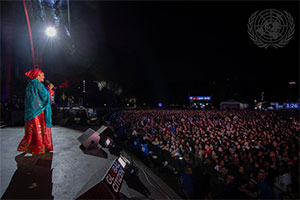 Global Citizen Festival in New York. Credit: UN Photo/Eskinder Debebe
Active citizens are committed to social change because they know that it is achievable. However, major political challenges face active citizens across the world. For example, in authoritarian regimes in Latin America where the hegemonic party has been in power for decades on end, protestors and human rights activists face enormous repression and struggle to materialize their advocacy into concrete results. The same can be said for Africans, where a shift towards elected government in recent decades has yet to translate into an effective voice in decision-making. Now, the Strengthening Citizen Demand for Good Governance, which uses evidence-based approaches – funded by DFID's Governance and Transparency Fund – seeks to raise their voices.
In 2025, the CIVICUS Monitor’s People Power Under Attack report revealed that civic freedoms are severely limited in 122 of 198 countries and territories, and only 7.2% of the global population now lives in countries where civic space is open. Through partnership with the Overseas Development Institute (ODI) and CIVICUS, IPS reporters across the continent will seek to define the extent and limits of state capability, government accountability and the responsiveness of leaders to the needs of citizens.

The Week with IPS

NEXT STOP - SDGs
Tracking global progress towards a sustainable world
Tracking global progress towards a sustainable world
