Languages
Wednesday, September 30, 2026



News and Views from the Global South
Food and Agriculture

Heatwave and Drought Hit South America’s Crops and Economy
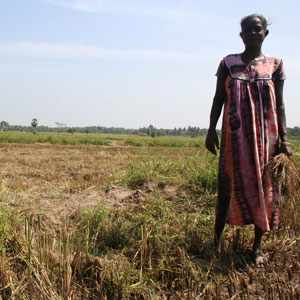
Brazil, Argentina and Paraguay, the three major agricultural producers in South America, are currently experiencing a prolonged period of drought and low water levels in their main rivers. This is severely impacting harvests, as well as river transport of important summer crops, with maize and soybeans the main casualties.
Our Global Food Systems Are Rife with Injustice: Here’s How We Can Change This
The pandemic – alongside growing threats from climate change, widespread malnutrition, economic instability and geopolitical conflict – has heightened problems with the ways we produce, distribute and consume food. And it’s made clear the urgent need to make global food systems more just.
Community Organization and Solidarity in Peru Tackle Hunger in Pandemic
It's nine o'clock in the morning and Mauricia Rodríguez is already peeling garlic to season the day's lunch at the Network of Organized Women of Villa Torreblanca, one of more than 2,400 solidarity-based soup kitchens that have emerged in the Peruvian capital in response to the worsening poverty caused by the partial or total halt of economic activities in the country due to COVID-19.
Asia-Pacific: Just 5% of the Region’s Population Owns 70% of Its Total Wealth
The Asia-Pacific region is experiencing growing inequality even while registering impressive economic growth and poverty reduction. Such sharp inequalities continue to be persistent in the region, with nearly 2 in 4 people still unable to afford a healthy diet.
A Call to Action on Living Lands
If the ocean is the lifeblood of the Commonwealth, then forests are the lungs that breathe life into its whole system. From the vast boreal woodlands of Canada to the rich primary forests of Papua New Guinea, the Commonwealth covers nearly a quarter of all forest land in the world - an estimated 900 million hectares. These biodiversity havens not only house about half of all animal species on earth, they also give us clean air, water and food, supporting the livelihoods of millions of people while tackling climate change.
Too Harmful: The March of Salt and Plastics on World Soils
There are more under-reported consequences of human activities unmatching the rhythm of Mother Nature. Such is the case, among many others, of the growing salinisation and ‘plastification’ of the world's soils.
Ecstasy as Zimbabwe’s Smallholder Farmers Secure European Pineapple Market
In her wildest dreams, smallholder farmer Sarudzai Sithole never imagined that her pineapples could someday stock the produce section of Europe’s finest supermarkets.
Why Does Yangtze River Have its Own Protection Law?
The new Yangtze River Protection Law (YRPL), which came into effect on March 1, 2021, is China’s first legislation on a specific river basin. The Yangtze River is China’s longest and largest river system, stretching over 6,300 kilometres and has over 700 tributaries. With a drainage basin covering more than 1.8 million square kilometres, approximately one-fifth of China’s total land area, the river basin is home to over 40% of the country’s population.
Rural Women in Peru Seed Water Today to Harvest It Tomorrow
"When I was a little girl we didn't suffer from water shortages like we do now. Today we are experiencing more droughts, our water sources are drying up and we cannot sit idly by," Kely Quispe, a small farmer from the community of Huasao, located half an hour from Cuzco, the capital of Peru's ancient Inca empire, told IPS.
Green Gas: Energy as a By-Product of Sugarcane in Brazil
First came sugar. For four centuries, it was the main sugarcane product in Brazil. But since the 1970s sugarcane has grown and diversified as a source of energy: ethanol, electricity and biogas.
Covid-19 Has Accelerated New Agtech Development and Adoption in Asia-Pacific!
While the COVID-19 impact has been predominantly negative, the pandemic appears to have sparked increased interest in developing agricultural technology (agtech) to improve the efficiency of food systems, from input supplies through farming and processing to delivery and retail.
2021 Revealed the Fragility of Food Systems
The end of this year has revealed the fragility of food systems when faced with sudden disruptions such as those observed during the COVID-19 pandemic. These disruptions have increased the number of people with limited or no access to food in the world. Today, more than 811 million people suffer from hunger, according to recent studies.
High Yield Seeds Could Address Food Shortages and Place Africa on Track to Zero Hunger – Experts
Rahab Munene’s shoe selling business crumbled at the height of COVID-19 in 2020. She traded the enterprise for a mobile grocery along the Thika Superhighway, Kiambu County.
Beyond Expo: Embedding the SDGs in the DNA of Future Technology and Innovation
A landscape of shared global challenges The COVID-19 pandemic has moved us farther away from the Sustainable Development Goals (SDGs). Data shows that the pandemic has pushed a further 124 million people into extreme poverty. Global poverty is now expected to be at 7% by 2030 – only marginally below the level in 2015. And with the global temperature increase already at 1.2 degrees, we are on the verge of the abyss. UN Secretary-General António Guterres is deeply concerned about the impact of the pandemic on the SDGs. But there is hope. He believes in the knowledge, science, technology, and resources to turn it around. He also urges further financing for development and climate action.

Cool Scheme to Reduce Food Waste in Nigeria
Food spoilage forced smallholder farmers out of pocket and out of business – until an entrepreneur came up with a cool idea.
How Vitamin-Enriched Foods can be the Gateway to Better Long-Term Nutrition
When one in five pre-school children is stunted due to chronic undernutrition, it is clear that global diets urgently need to improve and diversify to include more nutrient-rich fruits, vegetables and animal-source foods.
What Will it Take to Turn Farmers Toward Climate-Resilient Superfood Millet?
Millet could be Africa’s silver bullet for combating anaemia – and apart from health benefits, it is climate-resilient.
High Global Fertiliser Prices Overshadow Malawi’s Farm Subsidy Programme
Ellena Joseph, a small-scale maize farmer in Chiradzulu District in Southern Malawi, finished preparing her field early in October.
From Fruit Waste to Gourmet Grub
When Bonolo Monthe’s neighbours discarded bucketsful of fallen ripe morula fruit from their backyard, she saw food and fortune going to waste.
Time Honoured Food Traditions, Pleasing for Palate and Planet
Balance is the absolute key, says Alia Chughtai, a journalist who started a catering service with filmmaker Akhlaque Mahesar, by the name of Aur Chaawal (And Rice), two years ago.
Why Seed Companies Fear México
Last month México’s Supreme Court provided hope for biodiversity, especially in the Global South, while flaming fear for seed companies. In a historic step, it ruled for corn advocates and against genetically modified (GMO) corn. The decision was a momentous act in country where maíz (corn) carries daily and sacred significance.« Previous Page — Next Page »


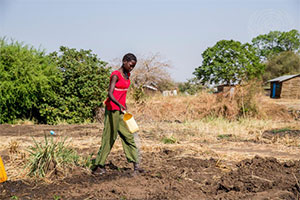 Farming on the Outskirts of Juba. Credit: UN Photo/JC McIlwaine
Promoting human and planetary health is a central focus of the United Nations, as laid out in the 2030 Sustainable Development Goals (SDGs). World hunger and unsustainable farming practices continue to be pressing concerns for the world. According to the 2025 State of Food Security and Nutrition in the World report by the Food and Agriculture Organization (FAO), 673 million people faced hunger in 2024. There are stark regional disparities, with the FAO projecting that 60% of the world population facing hunger will reside in Africa by 2030. Globally, the prevalence of food insecurity has remained consistently higher for women than men.
Sustainable and efficient national food systems are essential in preserving health, education, environmental well-being, peace, economy, and security. However, creating sustainable food systems can be a challenging endeavor, as food production takes a heavy toll on the environment. The agricultural sector accounts for a significant portion of greenhouse gases. Finding safe, sustainable, and ethical strategies to feed the world is crucial in ensuring planetary longevity. A recent initiative from 2023, the EU Regulation on Deforestation-free Products (EUDR), seeks to advocate for sustainable food systems. The main driver of deforestation is the expansion of agricultural land used to produce commodities like cattle, wood, cocoa, coffee, etc. The EUDR is part of the 2020 European Green New Deal and the EU Biodiversity Strategy for 2030 and aims to limit Europe’s consumption of products linked with deforestation by requiring that companies prove that their products are deforestation-free. Despite aiming to achieve major strides in sustainability, policies such as EUDR also raise socioeconomic concerns for targeted countries. Many emerging Latin American economies are impacted by the policy, and have raised the question of how developing countries can grapple with the tensions between economic development and advancing sustainability.
IPS has been at the forefront of providing compelling and insightful stories on communities facing hunger as well as the cost of food production. IPS uses statistics from FAO, the World Food Programme (WFP) and the International Fund for Agricultural Development (IFAD) to bring relevant and hard-hitting facts to readers. This gathering of information and data from such organizations helps bring the best stories from IPS journalists working in the different regions in consultation with experts on the ground.

The Week with IPS

NEXT STOP - SDGs
Tracking global progress towards a sustainable world
Tracking global progress towards a sustainable world