Languages
Sunday, September 20, 2026



News and Views from the Global South
Aid
The Medicines Are Fake, the Illnesses Real
Reports of fraudulent medicines in the south-west Pacific island states of Solomon Islands and Papua New Guinea have drawn attention to the need for more public awareness of the lethal trade and its tragic consequences.Nairobi Attack Exposes Flawed U.S. Terror Policies
In the aftermath of the worst terror attack in East Africa in three years, foreign policy scholars here are urging the U.S. government to rethink its counter-terror policy in the region.
Q&A: Congolese Wrongly Branded as “Pathological”
Western analysts all too often take a distorted and reductionist approach to the conflict in the Democratic Republic of Congo (DRC), says Kai Koddenbrock, who analysed more than 50 policy papers for a study published in the journal International Peacekeeping in November 2012.
U.S. Urged to Curb Militarisation in Latin America
The United States needs to phase down its drug war and tighten the reins on its cooperation with local militaries and police in Latin America, according to a new report released here Wednesday by three influential think tanks.OP-ED: Financing of Disaster Risk Reduction Needs Urgent Reform
Over 20 years, disaster losses in developing nations have amounted to 862 billion dollars (a considerable under-estimate). During this period the international community has spent just 13.5 billion dollars on disaster risk reduction (DRR), equivalent to 40 cents of every 100 dollars of development aid – this has to change.
Nigerians Uncertain of Future in Bakassi Peninsula
Thomas Effiom, a 35-year old fisher in Jabane, a small locality in Cameroon’s Bakassi Peninsula, scoops off floodwaters from the muddy floor of his house. It is a ritual he performs each time the Atlantic Ocean overflows.
The Emerging Economies and the G20 Summit at St. Petersburg
The eighth G20 Summit convened in St. Petersburg on Sept. 5-6, 2013 was dominated by the Syrian crisis, deflecting attention from the mandate of the gathering to serve as the premier forum for international economic coordination.
Forest Communities Draw a REDD Line
As the ink dries on a 3.6 million dollar agreement between Uganda and the World Bank to support the country's preparations for REDD, some analysts are pessimistic over the mechanism's potential.
OP-ED: Getting Children Into Somalia’s Classrooms
Somalia is well-known for being a country torn apart by decades of conflict, by hunger and instability. Today, with fragile stability emerging and a new government in place, there is an opportunity to define a new future of peace, prosperity and justice.
U.S. Debates Climate Impact of Development Investments
A debate is heating up here over the extent to which U.S. government-facilitated private-sector development investments should be required to take into account how those ventures impact on climate change.
DRC Peacebuilding Ignores Local Solutions
Despite existing local expertise and strategies in the Democratic Republic of Congo (DRC) to build peace-supporting structures at the community level, official debates and media coverage continue to focus predominantly on military interventions.
Somali President Rides Through a Bumpy Year
After his first year as president of the world’s most dangerous and failed state, Hassan Sheikh Mohamud is still grappling with limited financial resources, corruption, a lack of service delivery, and the ongoing assassinations of government officials, including attempts on his own life.
Europe Failing Syrian Refugees
Refugee rights organisations are demanding an EU-wide temporary protection regime for Syrian refugees. The announcement by some countries that they can take a few thousand refugees is not enough, the groups say.
Preoccupied with Syria, U.S. Still Saddled with Egypt
The United States, which is preoccupied with the ongoing political and military developments in Syria, is still saddled with an unresolved problem elsewhere in the Middle East: the military takeover of Egypt's first democratically-elected government.
Africa in Debt to Brazil: Forgiveness Isn’t Always Free
The Brazilian government projects the cancellation of nearly 900 million dollars in debt owed by a dozen African countries as a gesture of solidarity. But others simply see an aim to expand the economic and political influence of South America’s powerhouse.
Mugabe’s Policies Starve Zimbabweans
Tambudzai Javangwe from Mwenezi district in southern Zimbabwe, has run out of food and each day she begs for hand-outs from well-wishers so that she can feed herself an her six orphaned grandchildren.
Cash Transfers a Strong Tool Against Inequality
Latin America’s cash transfer programmes are a more effective weapon against poverty and social inequality than economic growth alone, according to a study by two Argentine economists.
Q&A: “We Need a Decisive Win Against Polio”
Africa and Pakistan are now battling outbreaks of polio, threatening the extraordinary progress the world has made in fighting the almost-extinct disease. In the Horn of Africa, there are now 121 reported polio cases. Last year, there were 223 worldwide. Siddharth Chatterjee has served as the chief diplomat, head of strategic partnerships and international relations at the International Federation of the Red Cross and Red Crescent Societies, the world’s largest humanitarian network, since June 2011.
Migrant Rights Defenders in Mexico Face Growing Pressure
"No one can stop me from working for migrants' rights, because no one is above my own conscience," said Mexican Catholic priest Alejandro Solalinde.
West Cold-Shoulders Rebuilding Southern Africa
The Southern African Development Community has had to revisit its plans to raise funding for its ambitious regional development plan in the wake of a cold-shoulder from western nations and multilateral finance institutions.
DR Congo Armed Groups Increase Child Recruitment
Over 2,000 children are still being used as soldiers by 27 armed groups in North Kivu in eastern Democratic Republic of Congo despite efforts by the United Nations Children’s Fund to remove them from the frontlines and return them to their homes.« Previous Page — Next Page »


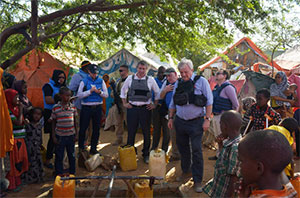 UN Emergency Relief Coordinator Visits Somalia. Credit: UN Photo/Tobin Jones
In recent years, conflicts have broken out across the world with no sign of slowing down or stopping. In times like this, millions of people globally are in dire need of humanitarian aid. Famine, warfare, natural disasters, and economic decline plague a host of nations, including Palestine, Sudan, Chad, Lebanon, and Haiti, to name a few. Humanitarian aid provides millions of people with critical services including healthcare, food, clean drinking water, psychosocial support, housing, and access to education. UN agencies such as the UNDP, UNICEF, the World Food Programme (WFP), UNHCR, UNRWA, and UNEP work with the UN Office for the Coordination of Humanitarian Aid (OCHA) and local organizations to come up with the best possible strategies to support affected communities. At the same time, humanitarian aid and those working on the frontlines are consistently threatened by both actors directly involved in conflict as well as those who are meant to contribute to the international humanitarian regime at large. The near-collapse of United States international aid structures in 2025, including the termination of 83% of USAID’s 6,300 global initiatives, has left millions of people without access to vital humanitarian assistance. 98 million people in 2025, only 65% of people targeted for humanitarian assistance, received the help they needed. In contrast, 123 million people received some form of humanitarian assistance in 2024, and OCHA’s 2026 Global Humanitarian Overview estimates that 239 million people are in need of assistance in 2026. IPS is well-positioned to discuss current initiatives to provide aid and relief through in-depth reporting and opinion content.

The Week with IPS

NEXT STOP - SDGs
Tracking global progress towards a sustainable world
Tracking global progress towards a sustainable world
