Languages
Saturday, November 28, 2026



News and Views from the Global South
Economy & Trade

OPINION: Towards a Global Governance Platform
Inter Press Service News Agency has braved severe political assaults and financial tempests since 1964, when Roberto Savio and Pablo Piacentini laid its foundation as a unique and challenging information and communication system.
OPINION: Boosting Resilience in the Caribbean Countries
Having lived and worked for more than a decade in four Caribbean countries, I have witnessed firsthand how Small Island Developing States (SIDS) are extremely vulnerable to challenges ranging from debt and unemployment to climate change and sea level rise.
The Time for Burning Coal Has Passed
“People have gathered here to tell their politicians that the way in which we used energy and our environment in the 19th and 20th centuries is now over,” says Radek Gawlik, one of Poland’s most experienced environmental activists. “The time for burning coal has passed and the sooner we understand this, the better it is for us.”
U.N. Conference Set to Bypass Climate Change Refugees
An international conference on small island developing states (SIDS), scheduled to take place in Samoa next week, will bypass a politically sensitive issue: a proposal to create a new category of "environmental refugees" fleeing tiny island nations threatened by rising seas.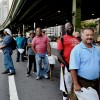
New York’s Homeless Pushed Deeper into the Shadows
Joe sits on newspapers spread on the sidewalk by the entrance to midtown's Grand Central Station. His head rests in his hands, only looking up when coins from passersby clink into his paper cup.
Bangladeshi Girls Seek Equal Opportunity
Until five years ago, Shima Aktar, a student in Gajaghanta village in the Rangpur district of Bangladesh, about 370 km northwest of the capital Dhaka, was leading a normal life. But when her father decided that it was time for her to conform to purdah, a religious practice of female seclusion, things changed.
When Land Restoration Works Hand in Hand with Poverty Eradication
Tugging at the root of a thorny shrub known as ‘juliflora’, which now dots the village of Chirmiyala in the Medak District of southern India’s Telangana state, a 28-year-old farmer named Ailamma Arutta tells IPS, “This is a curse that destroyed my land.”
Innovation Offers Hope in Sri Lanka’s Poverty-Stricken North
In this dust bowl of a village deep inside Sri Lanka’s former conflict zone, locals will sometimes ask visitors to rub their palms on the ground and watch their skin immediately take on a dark bronze hue, proof of the fertility of the soil.
Cuba Sees Its Future in Mariel Port, Hand in Hand with Brazil
The Mariel special economic development zone, the biggest construction project undertaken in decades in Cuba, emerged thanks to financial support from Brazil, which was based on political goodwill, a strategy of integration, and business vision.
Dumping Ban Urged for Australia’s Iconic Reef
Increased effort is needed to protect Australia’s iconic Great Barrier Reef, which is in serious decline and will likely deteriorate further in the future, according to a new report.
Organic Farming Taking Off in Poland … Slowly
Polish farmer Slawek Dobrodziej has probably the world’s strangest triathlon training regime: he swims across the lake at the back of his house, then runs across his some 11 hectares of land to check the state of the crops, and at the end of the day bikes close to 40 kilometres to and back from a nearby town for some shopping.
Zambia’s Cash Transfer Schemes Cushion Needy Against Climate Shocks
“Last season, I lost an entire hectare of groundnuts because of a prolonged drought. Groundnuts are my hope for income,” says Josephine Chaaba, 60, from Pemba district in southern Zambia.
U.S., Brazil Nearing Approval of Genetically Engineered Trees
The U.S. and Brazilian governments are moving into the final stages of weighing approval for the commercialisation of genetically engineered eucalyptus trees, moves that would mark the first such permits anywhere in the world.
Caregiving Exacerbates the Burden for Women in Cuba
Hortensia Ramírez feels like she needs more hands to care for her 78-year-old mother, who suffers from arteriosclerosis, do the housework, and make homemade baked goods which she sells to support her family.
Karachi Residents Trapped Between Armed Assassins and Private Bodyguards
With a rise in sectarian killings, extortion, drug peddling, kidnappings and land grabbing, Pakistan’s sprawling port city of Karachi, home to some 20 million people, has become a hotbed of crime.
In Saving a Forest, Kenyans Find a Better Quality of Life
When Mercy Ngaruiya first settled in Kasigau in south eastern Kenya a decade ago, she found a depleted forest that was the result of years of tree felling and bush clearing.
India: Home to One in Three Child Brides
Basanti Rani*, a 33-year-old farmers’ wife from the northern Indian state of Haryana, recently withdrew her 15-year-old daughter Paru from school in order to marry her off to a 40-year-old man.
A Life Reserve for Sustainable Development in Chile’s Patagonia
The people of Patagonia in southern Chile are working to make the Aysén region a “life reserve”. Neighbouring Argentina, across the border, is a historic ally in this remote wilderness area which is struggling to achieve sustainable development and boost growth by making use of its natural assets.
Can Land Rights and Education Save an Ancient Indian Tribe?
Scattered across 31 remote hilltop villages on a mountain range that towers 1,500 to 4,000 feet above sea level, in the Malkangiri district of India’s eastern Odisha state, the Upper Bonda people are considered one of this country’s most ancient tribes, having barely altered their lifestyle in over a thousand years.
Island States to Rally Donors at Samoa Meet
Amid accelerating climate change and other challenges, a major international conference in the South Pacific island nation of Samoa next month represents a key chance for Small Island Developing States (SIDS) in the Caribbean to turn the tide.
U.N. Prepares for Overhaul of Arms Trade Reporting
The Arms Trade Treaty is about to provide the biggest shake-up to conventional arms trade transparency since the end of the Cold War.« Previous Page — Next Page »


 UN Commission on International Trade Law Holds Colloquium on Harmonizing Law in Age of Digital Trade and Finance. Credit: UN Photo/Manuel Elías
Trade has historically been a geopolitical tool that can both be used to propel development as well as entrench inequalities. In various nations in East Asia and Latin America, increased trade, as often seen in export booms, has allowed them to achieve influential standings within the global economy. On the other hand, many low-income countries in Sub-Saharan Africa, Asia, and Latin America struggle to maintain a robust trade performance, and oftentimes are subjugated to exploitative trade dynamics through intense extraction of their natural resources. In recent decades, international trade has reached a new era as emerging economies across the world are rising in economic preeminence. Stable international trade is crucial to world peace as global interconnectedness facilitates reliable diplomacy. Nevertheless, significant challenges are on the rise. Notably, a major wave of United States tariff escalations in January 2025 lifted US import taxes to their highest level since the 1930s, changing market dynamics and forcing renegotiations with global trading partners.These articles are aimed at informing readers about the complexities of trade and its varying effects on development, with a special focus on the consequences of the global economic crisis, the potential of fair trade and the gender implications of trade policies.
Updated by Yilan Batista and Shuli Wong August 2026

The Week with IPS

NEXT STOP - SDGs
Tracking global progress towards a sustainable world
