Languages
Friday, November 13, 2026



News and Views from the Global South
Education
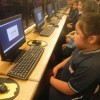
Paraguayan Radio Station Buses Internet to the Barrios
"I want my own computer so that I can talk to my cousins who live in Italy," says eight-year-old Camila Ojeda, sitting in front of a computer monitor on a bus that acts as a mobile cybercafé in the Paraguayan capital.Anger Boils Over as Ranks of Jobless Youth Swell
When images of North London's gutted and burning buildings, broken shop windows and refuse-lined streets appeared on TV screens and front-page headlines during the four-day Tottenham riots last August, many dismissed the damage as the work of "hoodlums" and "delinquents".UNICEF Funding Falls Short Leaving Millions of Children at Risk
If the United Nations Children’s Fund (UNICEF) had 1.28 billion dollars it could help 97 million people around the world.
Radio Static for Ghana’s Community Stations
There is a tension resonating through Ghana’s airwaves, an electric current fueled by rivaling interests between community radio advocates and Ghana’s National Communications Authority.PAKISTAN: Violence, Death Stalk Child Domestic Help
"He was a happy child, my younger brother," Mohammad Ramzan, 18, reminisced, his voice steeped in sadness.THAILAND: Malay-Muslim Insurgency – Lessons Learnt
Teachers’ Day on Jan. 16 was a sombre affair in Thailand’s troubled southern provinces where memories are strong of 155 educators killed over the past eight years in an insurgency led by Malay-Muslim separatists.EUROPE: Separate Schools for Roma Challenged
A school in Slovakia has defended its decision to segregate Roma children from other students after a court ruled the practice breached equal rights laws.SRI LANKA: Female Unemployment Rises With Education
Every weekend it has been the same ritual for so many months. Buying the newspaper, going through the classified and the employment sections inch by column inch, marking job offers that could offer a chance, even remotely.PAKISTAN: Girls Defuse This Taliban Bomb
Suicide bombing is down, bomb attacks are fewer, but the Taliban are keeping up attacks on girls’ schools. In retaliation, a growing number of girls are going for school education – without school buildings.
SOMALIA: Rebuilding Among the Rubble
With vehicles and donkey carts packed with their belongings, Somalis are returning, four years after they fled, to their partially standing, bullet-scarred and mortar-shelled neighbourhoods in former Al-Shabaab controlled areas of Mogadishu.SOMALIA: Taking Schools Back From Militants
Schools are beginning to re-open slowly in areas of capital Mogadishu that were until recently controlled by the militant Islamic group al-Shabaab. But an estimated 80 percent of students have not yet returned.
MALAWI: Women’s Education the Path to the Presidency
On an elegant veranda adorned with a red carpet, Malawi's Vice President Joyce Banda recalls how her childhood friend Chrissie Mtokoma was always top of their class and how she struggled to beat her. But now decades later Banda is a likely contender for the country's presidency in 2014, while Mtokoma lives in poverty.
CANADA: Alternative School Sparks Fears of Division and Isolation
The Toronto public school board has approved the second 'Africentric' Alternative School despite persistent criticism that the format attracts mainly black students and is equivalent to segregation in a country that prides itself on national unity regardless of ethnic differences.
At the Nexus of Agrofuels, Land Grabs and Hunger – Part 1
While the United Nations climate talks in Durban enter their ninth day of political feet-dragging, researchers and peasants around the world are busy connecting the dots between so- called "green climate solutions", industrialised agriculture and chronic hunger.
Opening Virtual Doors for People with Disabilities
As the International Day for Persons with Disabilities approaches this Saturday, one institution is working to remove some of the barriers that prevent disabled people from taking a leading role in policies that affect their lives.
Global Fund for Education Gathers Momentum
If the international community can successfully raise billions of dollars to fight deadly diseases, why not a similar fund to promote education, asks Gordon Brown, former British prime minister.
Celebrity Power Boosts U.N.’s New Anti-Trafficking Campaign
It happens every day across the globe, with many of its young victims lured by false promises into the world's third most profitable criminal activity. This is human trafficking.
CHILE: Student Protests Spread Throughout Region
In support of Chile's ongoing student protests, and voicing their own demands, thousands of people took to the streets in more than a dozen cities in Latin America Thursday demanding quality public education.
Occupy Oakland Rallies Amid Anger over Pepper-Spraying of Students
Twice evicted from its encampment just outside city hall, Occupy Oakland sprung back to life Saturday, erecting a new three-dozen-tent camp and defying multiple city warnings that lodging in public spaces would not be tolerated.EL SALVADOR: Giving Young Slum Dwellers a Chance
In a country where hard-line policies have failed to make a dent in soaring levels of violent crime, Salesian priest José María Moratalla has produced good results by offering educational and vocational opportunities to juvenile offenders and young people at risk of falling into crime.U.S.: The ‘School to Prison Pipeline’: Education Under Arrest
Metal detectors. Teams of drug-sniffing dogs. Armed guards and riot police. Forbiddingly high walls topped with barbed wire.« Previous Page — Next Page »


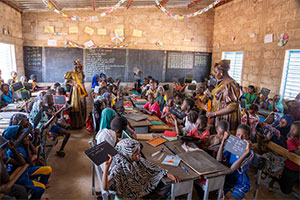 Two teachers work in a classroom in Forces Vives School in Dori, Burkina Faso. Credit: UNICEF/UNI978361
Safe and uninterrupted education is a fundamental right for all children. Education is paramount to global development, as it has been proven that investing in education – especially for girls and children – contributes significantly to economic growth and prosperity. Although more than 1 billion children go to school, many are subjected to conditions that are not conducive to a proper learning environment, including makeshift facilities, a lack of supplies, violence in classrooms, inadequate sanitation, untrained instructors, and widespread school closures. Since 2015, there have been immense gains in education with an increase of 109 million children in school. However, as of 2023, 272 million children are still out of school.
High poverty levels in developing countries also impede children’s access to a proper education. For example, from the early to mid 2000s, Sub-Saharan African nations witnessed a dramatic decline in trained teachers due to inadequate funding in the education sector. Furthermore, major cuts to United States international aid threaten an estimated 23 million additional children's access to education, as USAID‑funded school programmes across Africa and Asia face closure.
Various other factors contribute to the decline of education, notably hunger, which has increased as conflict and climate change interfere with global food production and dissemination. Meanwhile, certain social and cultural practices also impede children’s access to education, with gender inequality, discrimination, child labour, and child marriages preventing millions of children from attending school. Economic conditions such as the inaccessibility of higher education also affect disenfranchised communities across the world. In extreme situations, such as warfare where educational facilities are destroyed in their totality, notably in Gaza and Sudan, entire generations of children might grow up without access to education. Rebuilding educational infrastructure is a long and arduous process, especially when violence persists across generations, and this significantly stunts the development of societal prosperity and stability.
IPS is dedicated to telling the shocking truths about worldwide education through impassioned opinion pieces and comprehensive articles, highlighting global issues that impede worldwide education and the courses of action being taken by organizations such as UNICEF and Education Cannot Wait.

The Week with IPS

NEXT STOP - SDGs
Tracking global progress towards a sustainable world
Tracking global progress towards a sustainable world
