Languages
Thursday, November 19, 2026



News and Views from the Global South
Humanitarian Emergencies
Promoting Human Rights Through Global Citizenship Education
Amid escalating conflicts and rampant violations of human rights all over the world, spreading “human rights education” is not an easy task. But a non-governmental organisation from Japan is beginning to make an impact through its “global citizenship education” approach.
U.N. Launches Ambitious Humanitarian Plan for Gaza
The UN agency for Palestinian refugees has launched an ambitious recovery plan for Gaza following the 50-day devastating war between Hamas and Israel which has left the coastal territory decimated.
U.S. Ground Troops Possible in Anti-ISIS Battle
U.S. combat troops may be deployed against the Islamic State of Iraq and Syria (ISIS) if the strategy announced by President Barack Obama last week fails to make substantial progress against the radical Sunni group, Washington’s top military officer warned here Tuesday.
The Good – and the Bad – News on World Hunger
The number of hungry people in the world has declined by over 100 million in the last decade and over 200 million since 1990-92, but 805 million people around the world still go hungry every day, according to the latest UN estimates.
Declining Majority Still Supports “Active” U.S. Role in World Affairs
Despite elite concerns about growing “isolationism” in the U.S. electorate, nearly six in 10 citizens believe Washington should “take an active part in world affairs,” according to the latest in a biennial series of major surveys of U.S. foreign-policy attitudes.
U.S. Bypasses Security Council on Impending Invasion of Syria
The U.N. Security Council (UNSC), the only international body empowered to declare war and peace, continues to remain a silent witness to the widespread devastation and killings worldwide, including in Palestine, Syria, Iraq, Libya, Yemen and Ukraine.
OPINION: Bishop Appeals to U.N. to Rescue Minorities in Northwestern Iraq
For decades, the minority Christian population of Iraq has been suffering hardships. But in the summer months of 2014 - and since the beginning of the military campaign by ISIS (Islamic State in Iraq and al-Sham, also known as ISIL or Islamic State) - the situation has gone from bad to intolerably worse.
Hamas Rocket Launches Don’t Explain Israel’s Gaza Destruction
Israel and its supporters abroad have parried accusations of indiscriminate destruction and mass killing of civilians in Gaza by arguing that they were consequences of strikes aimed at protecting Israeli civilians from rockets that were being launched from very near civilian structures.
OPINION: From Schools to Shelters in Iraq
Using schools for shelter was a natural. When the Islamic State drove waves of people from the Sinjar area of Iraq in early August, most of them members of the Yazidi minority group, they fled first to the mountains and then to the relative safety of Iraqi Kurdistan. They camped out in whatever unoccupied structures they could find.
U.S. Military Joins Ebola Response in West Africa
The U.S. military over the weekend formally began to support the international response to the Ebola outbreak in West Africa.
War Over but Not Gaza’s Housing Crisis
“When the [Israeli] shelling started, I gathered up my family and headed for what I though was a safe place, like a school, but then that became overcrowded and lacked sanitation, so we ended up in the grounds of the hospital.”
New Operation Could Hide Major Shift in Europe’s Immigration Control Policy
‘Mare Nostrum’ – the largest search and rescue immigration operation ever carried out in the Mediterranean Sea – has become an issue of bitter brinkmanship between human rights groups and anti-immigrant lobbies.
No Easy Choices for Syrians with Small Children
The woman who walked into the Islamic Front (IF) media office near the Turkish border was on the verge of fainting under the hot Syrian sun, but all she cared about was her infant son.
OPINION: Iraq On the Precipice
The catastrophic events in Iraq that are unfolding daily are more significant than at any point in recent memory.
Mass Deportations Don’t Squelch Migration Dreams of Hondurans
The clock marks 9 AM when a bus coming from the Mexican city of Tapachula reaches Corinto, on the border between Honduras and Guatemala. It is the first bus of the day, carrying children and their families sent back from a failed attempt at making it across the border into the United States.
Criminalisation of Homelessness in U.S. Criticised by United Nations
A United Nations panel reviewing the U.S. record on racial discrimination has expressed unusually pointed concern over a new pattern of laws it warns is criminalising homelessness.
The Age of Survival Migration
“Survival migration” is not a reality show, but an accurate description of human mobility fuelled by desperation and fear. How despairing are these migrant contingents? Look at the figures of Central American children travelling alone, which are growing.
South Sudan’s Hip Hop Artists call for Peace and Reconciliation Through the Unhip Practice of Farming
“What is the benefit when children are crying and people are dying due to hunger? There is no need to cry when you have the potential to dig,” sings Juba-based dancehall reggae group, the Jay Family, in their latest single “Stakal Shedit,” which means “Work Hard” in Arabic.
Civil Society Condemns Immunity for Sitting African Leaders Accused of Serious Crimes
Mary Wacu lived in the Rift Valley region for 10 years prior to the 2007/08 post-election violence that rocked Kenya after a disputed general election.
Nepal Landslide Leaves Women and Children Vulnerable
Living in a makeshift tarpaulin shelter, which barely protects her family from the torrential rainfall or scorching heat of this remote village in southern Nepal, 36-year-old Kamala Pari is under immense stress, worrying about her financial security and children’s safety.
OPINION: Boosting Resilience in the Caribbean Countries
Having lived and worked for more than a decade in four Caribbean countries, I have witnessed firsthand how Small Island Developing States (SIDS) are extremely vulnerable to challenges ranging from debt and unemployment to climate change and sea level rise.« Previous Page — Next Page »


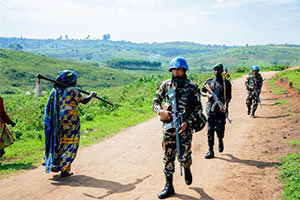 MONUSCO Peacekeepers and FARDC Soldiers Patrol Fataki Area. Credit: UN Photo/Jorkim Jotham Pituwa
Conflict, human rights violations, natural disasters, and famine have been at the forefront of concerns for humanitarian organizations. The escalation of humanitarian crises has led to over 239 million people in need of humanitarian assistance at the start of 2026, as estimated by OCHA’s Global Humanitarian Overview. The 2025 humanitarian appeal received only $12 billion, the lowest funding in over a decade, which has left 24 million fewer people reached in comparison to 2024. Conflict has remained the primary driver of crisis.
Humanitarian emergencies massively impact progress towards the Sustainable Development Goals (SDGs), adversely affecting economic development, inequality, education, planetary well-being, and poverty. Millions of people are faced with reduced access to essential services, including shelter, food, healthcare, and access to clean drinking water. UN Organizations such as UNHCR and the United Nations Children’s Fund (UNICEF) are committed to providing direct relief to affected communities when state governments cannot.
The United Nations 2024 Summit of the Future discussed measures that will be taken to reduce global inequality and promote peacekeeping efforts around the world. The recent UN Climate Change Conference (COP30) in Belém, Brazil, agreed to mobilize $1.3 trillion annually for climate action by 2035, operationalize the loss and damage fund, and triple adaptation finance. However, a fossil fuel transition commitment was not secured, despite climate change and the greenhouse effect being major contributors to humanitarian crises worldwide.
Countries across the world have also rallied to end humanitarian crises, as witnessed in conflicts such as Palestine and Ukraine. IPS is committed to providing relevant and in-depth reports of humanitarian emergencies around the world and their implications.

The Week with IPS

NEXT STOP - SDGs
Tracking global progress towards a sustainable world
Tracking global progress towards a sustainable world