Languages
Friday, November 20, 2026



News and Views from the Global South
Human Rights

Reject Abusers from UN Human Rights Council: Advocacy Groups
The Human Rights Foundation (HRF) and the UN Watch have called on UN member states to oppose the bids of some of the major human rights abusing governments from joining the Human Rights Council (HRC).
Unexpected Eritrean Journalistic Voice Rises in Ethiopia
It took Eritrean journalist Estifo* seven years to save up enough money to pay a fixer to get him and his family from the capital, Asmara, to the shared border with Ethiopia. After they crossed the border by foot, they turned themselves in to the Ethiopian authorities and claimed asylum as refugees.
Antonio Guterres Selected as Next UN Secretary-General Faces Tremendous Challenges
The 15 members of the UN Security Council jointly announced Wednesday their decision to select Antonio Guterres of Portugal as the ninth Secretary-General of the United Nations.UN Unable to Fully Investigate Chemical Weapons Allegations in Sudan
The UN has only limited access to Jebel Marra, the location in Sudan where Amnesty International alleges Sudanese government forces have used chemical weapons, UN Peacekeeping Chief Herve Ladsous said here Tuesday.
‘The Earth Is Not Flat; It Is Urban’
When the United Nations elaborated its latest report on the impact of what it calls “the dramatic shift towards urban life,” it tried to draw a balanced portrait of both the opportunities and the challenges of the fact that 1 in 2 world inhabitant already lives in urban areas and what this implies.
The UN’s Blind Spot for Conflict Prevention
As the world struggles to respond to conflicts and the people fleeing them, UN insiders are also struggling to advance a ‘shift in mindset’ to help prevent these crises from happening in the first place.
Environmental Crimes Could Warrant International Criminal Court Prosecutions
The International Criminal Court (ICC) will pay more attention to crimes of environmental destruction and land-grabs, according to a new policy paper published by the court.
UN Resolution on Journalist Safety Passed, But Long Way to Go
The UN Human Rights Council (UNHRC) advanced its commitment to the safety of journalists after adopting a groundbreaking resolution with measures for states to ensure journalist protection. But this is only the first step, many note.
Murders, Crackdown Create Lingering Climate of Fear in Bangladesh
Like the living room of any proud family, the one in Ajoy Roy’s house boasts photos of the eldest son, Avijit.
Uncertainty Mars Potential for Peace in South Sudan
Nearly one month after UN Security Council members visited troubled South Sudan, disagreement reigns over even the limited outside measures proposed to try to bring the security situation in the world's newest country under control.
Colombia Referendum – First Acid Test for Peace
It was like a huge party in Colombia. “Congratulations!” people said to each other, before hugging. “Only 20 minutes to go!” one office worker said, hurrying on her way to Bolívar square, in the heart of Bogotá. And everyone knew what she was talking about, and hurried along too. Complete strangers exchanged winks of complicity.
South Sudan and Uganda’s Intertwined History of Violence
Uganda has and continues to play a major role in fueling the conflict in South Sudan. The recent events in South Sudan have brought that moral challenge into a very sharp focus.
Unregulated Promotion of Mining in Malawi Brings Hazards and Hardships
Nagomba E. is no longer young; her hip is giving her trouble and her back is stooped from years of bending over her corn and rice fields. Yet every morning, at the crack of dawn, the wiry 74-year-old sets out on a strenuous half-hour walk to fetch water from a nearby river so that her ailing husband can take a bath. Despite her limp, Nagomba moves fast and with the sure-footedness of a mountain goat.A Historic Day in Colombia
Betsaida and her family abandoned their home and a small business in the port of Tumaco, in the Pacific of Colombia, and were forced to follow the road that more than 7 million displaced Colombians have as a result of the armed conflict. Their story, and that of millions of victims of the war, is at the heart of what the United Nations Organization is and does. Seventy-one years after its creation, the universal aspiration to end war, reaffirm the fundamental human rights and promote social progress is latent and more crucial than ever.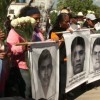
Two years on, Peña Nieto cannot brush off Ayotzinapa stain
There are certain events that mark a turning point in a country. The way a government decides to handle them defines the way they will go down in the history books.
Mexico City’s Expansion Creates Tension between Residents and Authorities
People living in neighborhoods affected by the expansion of urban construction suffer a “double displacement”, with changes in their habitat and the driving up of prices in the area, in a process in which “we are not taken into account,” said Natalia Lara, a member of an assembly of local residents in the south of Mexico City.
The Lost Kids at Rome’s Termini Station: Child Migrants Exploited
Rome ..... Termini station, 2:00 pm on a Tuesday afternoon. Five young boys are standing next to the escalators, constantly shifting, dispersing, meeting up again. They are laughing, typing on their phones, chatting, smoking. They seem like average teenagers with fancy hairstyles and smart clothes. But every once in a while, they nervously glance over to the security personnel circling Termini station. Or carefully examine older men walking by.
Population Growth Extremes: Doublers and Decliners
While the world’s population of 7.4 billion is growing at 1.1 percent per year – about half the peak level of the late 1960s – enormous differences in demographic growth among countries are increasingly evident and of mounting concern to countries and the international community.
Community Conversations in Ethiopia Prevents Exploitative Migration
Five years ago, when Meliya Gumi’s two daughters, Gifty* and Chaltu,* aged 16 and 18, migrated to Dubai and Qatar respectively, as domestic workers, everyone thought they were moving towards a better future. As a widowed mother of eight with little resources, living in the village of Haro Kunta in the Oromia region of Ethiopia, Gumi had a difficult time making ends meet.
UN Refugee Summits Fall Short for Children
As Olympic swimmer Yusra Mardini opened the floor for US President Barack Obama’s leaders’ summit on refugees, she embodied a hope unavailable to most child refugees.
Yazidi Survivor of ISIL Appointed UN Goodwill Ambassador
Yazidi Nadia Murad - who survived being kidnapped and forced into sexual slavery by ISIL - was honoured by the UN on Friday September 16 for her work to help human trafficking survivors.« Previous Page — Next Page »


One world, one humanity, now one court to defend its rights. Another step towards universal human rights, but not remotely a step far enough. The United Nations adopted the Universal Declaration of Human Rights more than half a century ago, but that has done little to stop violations the world over, just as the Geneva Convention has not protected prisoners of war enough. Democracy itself and the freedom it presupposes has not been protective enough. This is the century to move from politicisation of human rights towards humanising political ways. IPS keeps an eye on that difficult path.

The Week with IPS

NEXT STOP - SDGs
Tracking global progress towards a sustainable world
Tracking global progress towards a sustainable world
